Showing posts with label Goa. Show all posts

Thursday, January 2, 2014

Mangueshi temple dedicated to Lord Shiva

Prologue :  My wife was apprehensive of visiting the Mangueshi temple in Ponda which was just a small detour from the highway to Ponda because of stereotype image of the community.  Luckily the power of Lord Shiva drew me to take a deviation by convincing her that it was enroute to Ponda towards Safa Masjid.  Being born on a Shivaratri day naturally i was attracted towards the destination.  Surprisingly i found foreigners too visiting the temple whereas Wikipedia mentions they are banned from visiting the temple because of indecent clothing.  However i found that these guys were dressed decently enough to enter the premises. 

Mangueshi temple is dedicated to incarnation of Lord Shiva, ironically Manga in kannada means Monkey.   He is revered as bhagwan of goa.  The lord is worshipped in the form of Linga.  A myth states that goddess Parvathi was frightened by a chasing tiger ( avatar of Lord Shiva ).  In her cry for help she uttered Trahi Mangesh instead of Trahi maam Ganesh. 


Mangueshi happens to be family deity of many Goan Hindus particularly Saraswath Brahmins.  They generally consume Fish particularly river fish which is considered to be vegetarian.  These GSB’s ( Goan Saraswath Brahmins ) are generally Konkani speaking and primarily a trading community.  One can find them throughout the konkan coast, who fleed from the Goan Inquistion from 1560-1812.

The temple had its roots in Bhagirathi river, the Brahmins bought the idol from the river bed to Gomantak, to establish the famous temple of Mangueshi on the banks of river Gomati or Zuari it is called currently.


Since the Portuguese persecution of 1560 during Inquistion, the Idol was shifted to the present location which was relatively safer at Ponda from Salcette.  The idol was housed in Ponda to prevent destruction of Idolaters.  The original structure was a simple hut, but later it was rebuilt into current edifice under the patronage of the Peshwas, who donated the village of Mangueshi in 1739.  Ironically once the superstructure was built and decline of Marathas took place, in 1764  Portuguese once again occupied the region.  However this time around the impact or zeal for conversion got reduced and it was disbanded due to intervention of the British in 1812.  Magueshi temple thus survived the occupation just like the Safa Masjid.  One common feature is that both the temple and masjid had lovely tanks, which prevented them from being demolished for their valuable source of potable water.

The Mangueshi temple seems to have been constructed around 1740’s with 7 storeyed lamp tower and main temple complex.  Later on guest houses were added on for devotees to spend some time during their visit to this place for lack of clean lodging in the area.  The complex contains a marriage hall which could accommodate 500 guests.


There are number of annual festive celebrations which is of significance they are Ram Navami, Akshya trithya, Navaratri, Dusherra, Diwali, Magha Poornima and finally Maha Shivaratri.  A temple guide is being sold in the premises for the GSB’s particularly spelling out all the rituals, timings and scriptures.   There is a vegetarian canteen in the basement of the Marriage hall serving good vegetarian dishes at reasonable prices.  I picked up home made goan masala to add to my kitty of shopping in Goa for preparing fish curry.

A meaningful life is not about being rich nor being popular, or being highly educated or being political perfect.....It is about being grounded to earth, being humble and able to to share,touch lives of others, it is only than we can have have contented and blissful life.
Ack : Wikipedia, Outlook Traveller Guide & Original surmise, Quote Unknown.

Safa Masjid Survives

 Prologue : Enroute to Mulki from Panjim on a Christmas day we were blessed to visit all the religious monuments of Goa.  Imagine visiting Mount Mary Church on the hillock, than Augustine tower at Old Goa, Mangueshi Temple at Ponda and Safa Mosque at Ponda on the bye pass towards Belgaum.  The caretaker appointed by the ASI revealed there were more than 27 mosques and other monuments which were destroyed by Portuguese during the inquisition from 1560 to 1812.  More than the Muslims, temples belonging to Hindus were destroyed without a trace of their existence.  It can be safely assumed that more than 200 temples were destroyed which were vestiges of Kadamba and Vijaynagar Empire.  Surprisingly Safa Mosque was constructed in 1560 when the inquisition just began survived.  The caretaker told me it survived because it was located in midst of a forest.  I just used my logical thinking to surmise probably it was because of Portuguese this wonderful mosque survived.  After chasing out the Muslims probably Portuguese higher ranking officials occupied the mosque and used it as a guest house by creating an outpost.  This theory is deduced by the fact that this mosque is located just 16 kms away from Old Goa which was the seat of Portuguese reign.  In all likelihood it was occupied in 1759 when the plague struck old Goa, when there was exodus of the population in all directions
Safa Shahouri Masjid is located just on the highway leading towards Belguam with a small deviation inside the the main road.  The premises is currently a protected monument under the ASI jurisdiction.  It has been beautifully landscaped and resurrected into a wonderful monument of historic importance.

Currently the Immam offers prayers in the mehrab and in the masjid at regular intervals.  The caretaker was kind enough to open the doors and give me a glimpse of the interiors of the Masjid without expecting any money. 

The next discovery was that of the much touted Adil Shah’s Palace, he showed me a calendar containing the pictures of Islamic structures currently existing.  It was an amazing discovery therefore i was tempted to photograph the same for posterity. 


The architecture of the tank is the main attraction in this premises.  The tank is almost the size of two basket ball courts.  Each side has 6 to 8 chambers with water being sourced from a spring nearby.  The purity of water can be gauzed from the fact that the residents draw water from the tank for their domestic use currently.


Overall photographs or videograph may not give an idea of this wonderful monument, one should experience the beauty of the resurrected premises by ASI in order to appreciate its conception.  Thank you Portuguese for preserving this monument for posterity.
Ack:  Outlook Traveller, Wikipedia and Original surmise

Wednesday, January 1, 2014

Bom Jesus Bascilica Beckons

Prologue :  This is most important Church in Goa considering its antiquity and importance.  It houses the well preserved body of St Francis Xavier, who is considered to be Goa’s patron saint. In my eagerness i casually enquired with one of the church supervisors regarding St Francis Xavier’s body exposition hurray it came as surprise that exposition is due in 2014 since it was exposed to public in 2004 last.  Maybe it calls for one more trip to Goa for many of us....

Bom Jesus Church is dedicated to Infant Jesus and we were privileged to visit the same on Christmas eve, what a coincidence.  This Church was elevated to the status of Bascilica in 1946.  The design of this church was supposed to be inspired from St Paul’s Church which is destroyed now.
The church was contructed by two priests, modelled on Italian renaissance style called Baroque.  Diogo De Borba collaborated with Minguel Vaz to build this magnificient edifice in 1541.  Next to the Bascilica Professed house for the Jesuits was bilt in 1589.


The three storied Bascilica is built with carved basalt embellishments.  The columns and corridors are fashioned in true renaissance style.  A carved basalt medallion depicts emblem of Society of Jesus on the top.  The facade is fashioned in Baroque style of architecture.  The main alter has a statue of St Ignatius Loyala, founder of the society of Jesus.  One can find a small statue of Infant Jesus below being patron of the Church. 

St Francis Xavier : ( 7th April 1506 – 3rd December 1552 ) The Saint was born in Javier, which is now part of Spain.  He was co-founder of Jesuits along with Ignatius Loyala, who took his vow in 1534 at Paris.  He was born in an aristocratic family, but due to constant war in Europe he was dragged into the feud.  His father died in 1515, he along with his brothers fought a futile battle of survival, in 1522 their castle was captured by the Spanish invaders.  He was fed up of the constant feud and later left to France for studies in 1525.  In 1530 he received a masters degree in Arts at College Sainte-Barbe in Paris.  He started teaching philosophy of Aristotle at Beauvais College, where he met Ignatius and became his constant companion.  Just when he was heading towards academic excellence he turned towards missionary life.  He was influenced by Ignatius uttering “ what will profit a man to gain the whole world, and lose his own soul”


On 15th August 1934, together with Ignatius and five other Jesuits they established the Society of Jesus in a Chapel at Montmarte.  They took a vow of Chastity,Poverty and Obedience.  They went to Venice to get ordained into priesthood in 1537.  He left on his mission of counter reformation in 1540 along with a book written by a Croatian Humanist Marko Marulic  De Institutione Bene Vivendi   
He was summoned the Portuguese King John III to Portugal to ensure that his subjects abroad do not stray away from Christianity due to liberal atmosphere prevailing in the Indian sub continent.  He sailed along with Viceroy Afonso De Sousa on board Santiago on 7th April 1541 from Lisbon to Muragoa. 
Francis Xavier discovered that many of the Portuguese were influenced by ambition, revenge, avarice and debauchery.  They ignored the tenets of Christianity and started ill treating the local populace with their arrogant behaviour.   He found that concubinage was openly practised by Europeans in general with seduction of natives.  During this period i have a sneaking suspicion that Siesta and Fiesta culture slowly started creeping into Goa.
He slowly started his saintly work of attending to patients in the hospitals and prison in the morning times.  Later in the afternoon he used to assemble the children and servants to preach morals and tenants of Christianity.  He was invited to St Paul’s College to lecture to priests in the seminary.  Thus began his slow process of reformation in Goa. 

Xavier set sail to Cape Comorin in Oct 1542, to reform the natives who had been baptized a decade earlier.  He was unable to convince the high caste Brahmins to reform.  He spent three years in south India in converting and spreading the tenets to natives.  His effort was hampered by the Portuguese soldiers who were short tempered and ill mannered.  He visited St Thomas Mount at Mylapore.  From there he travelled eastward in 1545 towards Indonesia, In 1547 at Malacca he met a Japanese named Anjiro, who helped him in spreading Christianity in Japan with the help of his translation. He became the first Christian who adopted the name Paulo De Santa Fe.
In 1548, he returned to Goa, to fulfil his responsibility and created a administrative infrastructure of the Church.  Once again in April 1549 he set sail for Malacca and Japan.  He wrote to his companion “ All the Portuguese merchants coming from Japan tell me, if I go there i shall do great service for God our Lord, more than pagans of India”
On 27th July 1549 he reached the shores of Japan, but was refrained from entering its territory until 15th August.  Shimazu Takahisa ( 1514-1571) gave a friendly reception to Francis on 29th September but forbade conversion of locals into Christianity next year under death penalty threat. 
Francis ultimately found that the tenets of poverty, chastity and simplicity did not appeal to the locals or royalty of Japan.  Further the language barrier proved to be a stumbling block for him to preach.  The middle path of Buddhism was firmly entrenched in Japan, even though Francis tried to convince the path of Jesus by using different methods. 
He set sail for China which was one of his main target in 1552 on Santa Cruz, he struck a deal with a Chinese man for large sum of money to take him to the mainland China.  Unfortunately he died on 3rd December 1552 due to viral fever. 
His body was first buried in the beach of Shangchuan Isle, later his body was exhumed in Feb 1553 was temporarily buried in St Paul’s Church in Portuguese Malacca on 22nd March 1553.  Ferriera came from Goa and shipped the body of  Francis Xavier on 11th Dec 1553 to Goa.  The body is finally resting Bascilica of Bom Jesus in Old Goa, wherein his body is placed in glassed coffin embedded with silver casket. 

Overall Francis Xavier was a patron saint of Christianity, he helped to spread the religion across S East Asia.  But his zeal to convert seems to be controversial since he recommended Inquistion to ensure conversion which commenced after 8 years of his death in 1560.  He managed to reform the Portuguese to an extent and convince the natives willingly to adopt Christianity.  Some of the writings of the Saint are disturbing and I am refraining from penning the same in the interest of maintaining communal harmony.  My history Professor Rao was highly critical of Francis Xavier stopping short of considering him as Satan, but history testifies that during his tenure Inquistion did not begin absolving him of misdeeds during Inquistion.  Let his body rest in peace in the Bascilica. Abrigado.               


Controversy surrounding the preserved dead body :  
Controversy surrounds the body of encased St Francis Xavier at Bom Jesus Bascilica.  It is alleged that the captain of the Portuguese ship was infuriated by the stink emanated from the corpse of  Xavier after being dead drunk, he ordered it to be thrown in the Indian Ocean.  Once he came out of the  hangover, he realised his blunder and wanted to repent for his grave sin.  A Buddhist Monks body who died in Sri Lanka, due to herbal poisoning, was switched.  Inorder to camouflage the Asian Skin the body was dipped in Limestone and Salt to preserve the body.  The descendents of the monk have been claiming the body to worship the saint whose body is still in pristine condition despite decades.  They are calling for DNA test which would comprehensively prove its gensis.  The Vatican church has opposed the symbolic move as heretic claim.  But the fact remains that a tall European can hardly be substituted with short Asian.  However the spirit of  the Saint needs to be respected and honoured rather than falsehood perpetuated for the soul is everlasting than its body.  The cannonisation of the saint took place in 1622.  May his soul rest in peace.

Epilogue : To fine tune a travelogue filled with history wherein a minority perpetuates a genocide and to strike a diplomatic balance with perspective is a difficult task, i think i have done justice......Guys if you all think that i have committed a blunder or propagated falsehood please let me know, after all we are subject to correction.

Ack : Outlook traveller, Wikipedia, Mangalorean.com, Ajit Vadakayil Blogspot & Original surmise.

Tuesday, December 31, 2013

Fort Tiracol symbolises freedom from Portuguese

Fort Tiracol is literally on the northern most tip of Goa, it is virtually the boundary of Maharastra.  It can be reached from the ferry point at Querim,  across the river tiracol or rather the back waters.  It can be approached from the newly constructed bridge on Vernem crossing into Maharastra and back to Triacol if one travels around 4 kms.  Another approach road is from Vengurla or Kudal rather to reach this destination.  It is almost 60 kms from Panjim via the coastal route via Calangute, Baga, Anjuna, Vagator beach road, via Siloli.  One has to keep Querim enquiring about the road deviations to reach this spot.

History :  The King of Sawantwadi Maharaj Khem Sawant Bhosle from the Shivaji clan built this fortress on the northern most tip of the Tiracol river to protect his territory from invasion by Portuguese and others from the sea front.  The hillock chosen to construct this fort had a vantage view of the Arabian sea and back waters of Tiracol river.  The name has its gensis in Marathi which signifies steep river bank ( Tri Khol ).  The fort initially sheltered a vast fleet of naval vessels of the Maharaja along with cannon turrets on the fortress.


But it was unsuccessful strategy, it attracted the attention of the 44th governor of Portuguese Pedro Miguel de Almeida, who defeated the king in a fierce naval and ground battle.  It lead to the surrender of the fortress to Portuguese in November 1746.  From than on Portuguese strengthened and revamped in 1764.  the maritime fort was reinforced by adding additional fortifications on the ramparts to encompass 12 cannons.   The fort was seized once again by the British who defeated the Marathas in 1819 and occupied the fortress.  The british had signed a treaty with the Portuguese in 1661, as a consequence of marriage of King Charles II and Catherine of Portugal, there was on and off friendly gestures between them.

Dr Bernardo Peres De Silva lead the first rebellion against the Portuguese during the civil war in 1825.  The Potuguese took shelter at Tiracol Fort to recoup.  Tiger Da Cunha entered the fortress and beheaded the entire garrison.  The fort was severally damaged in the rebellious attack and the Chapel was later rebuilt.

On 15 August 1954, the sathyagrahis entered the fort and raised the Indian Tri colour.  They were later captured and imprisoned in the fortress.  A church of Holy Trinity was constructed in its courtyard which later came to be known as St Anthony’s church, which is now in state of ruins.  The church is not open to public.

It is sad that such a historic fort is run as a heritage hotel, currently under renovation with only 7 rooms.  It could be converted as a historic museum and monument signifying freedom from Portuguese.

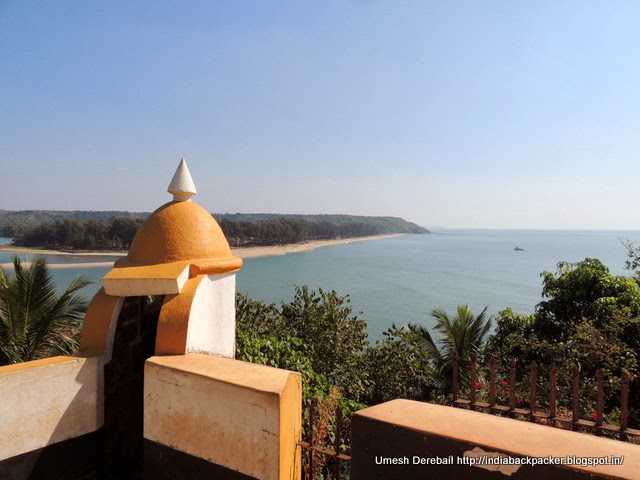
One can have a birds eye view of the Tiracol beach from the ramparts of the fort.  It also provides a panaromic view of the landscape, there is a memorial constructed on just outside the fortress for the freedom fighters who lost lives during the liberation of goa in 1961 through operation Vijay and other rebellions in the past which were unsuccessful.  Overall a visit to Tiracol takes us back to the legacy of freedom struggle from the british as well as the Portuguese.

avinash

avinash
cannons ready to fire

About Me

My photo
Bangalore, Karnataka, India
Basically i am down to earth, take friendship to its logical end. It is my endeavour to create a wealth of co-operative ventures. Basically being a marketing man i have the acumen to spot winners. I am privileged to travel the length and breadth of the country, courtsey my father, who was with Indianoil, my employers such as Nutrine, Kurl-on, Hindustan Pencils, Prestige, Crystal, Bell Ceramics, Pentel, Sezal, Commander. Currently i am involved in Tourism, Booking Air Tickets, Agent for Jungle Lodges and Resorts Limited and Taj Group of Hotels and a numerous hotels across India. Depending on the needs of a traveller i would recommend the destination and accommodation best suited to their budget. Humour takes me on. Let us have a win win situation for all. I love travelling for sake of adventure, photography and discovering the heritage. Life is a journey and let us enjoy our drive. Come share your travel experience on indiabackpacker.