Showing posts with label hampi. Show all posts

Saturday, September 3, 2011

Circuits around Hampi....Domed Structure


ASI records on the premises of Anantasayana Temple mentions that this temple was dedicated by Krishnadevaraya in 1524 AD in reverance to Lord Ananthpadmanaba.  This temple town Sale was dedicated to his son Tirumala, who seems to have been killed in a conspiracy hatched for succession.  The prime suspect was Timmarsu, who was a trusted commander of  Krishnadevaraya.  He was blinded and imprisoned for his involvement.  

This temple has seen maximum destruction and vandalism, the temple roof seems to have borne the brunt of a raging fire.  Most of the structures have collapsed, which is being resurrected by ASI expertise.  A massive support pillar is erected at the main temple premise, which is almost dividing the entrance to the temple as in and exit to the premise.  The temple had the idol Lord Vishnu in reclining posture at the Garbagriha or sanctum, which is probably safely displayed at ASI museum in Kamalapuram.

There are one other small temple which is dedicated to Devi.  The main temple is huge with three doorways and number of pillars on which different mythical characters are etched.  

Currently since the renovation work is underway one can find children playing cricket, and the boundary wall  acts a protection.  The dome of the temple is almost 10 meters which reveals the skill of the architects concerned.  


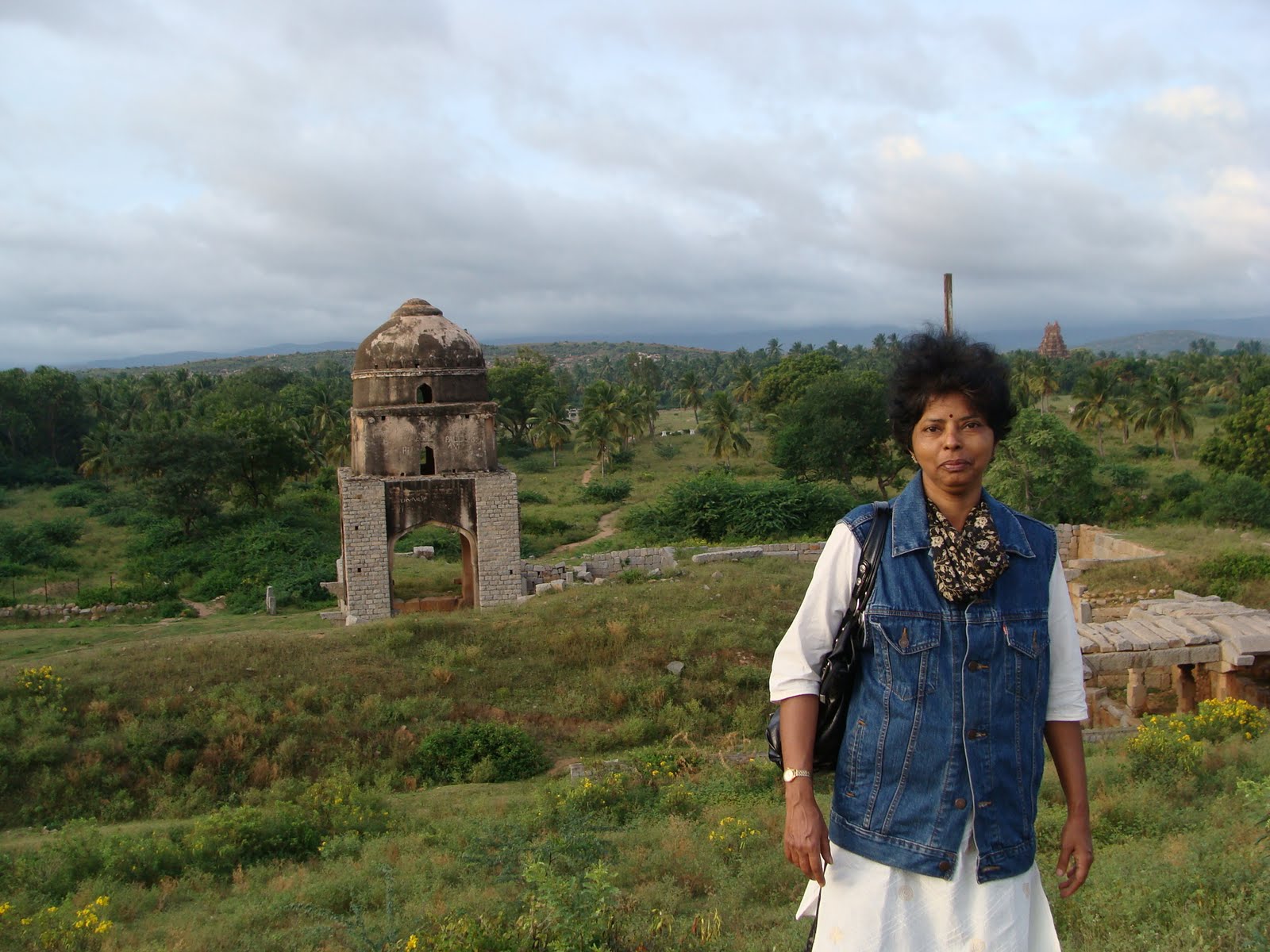
A doomed structure temple is located in the remote Pushkarni site, which is being salvaged by ASI.  This site is not accessible by road, one has to trek either on the reservoir or behind the Pattabhi rama temple.  

This tank ( Pushkarni ) which is adjacent to Pattabhirama temple,   is being salvaged by ASI to regain its past glory, with pillars being erected.  Some of the stone slabs are newly laid in the absence of the original stones.

The incomplete Dome structure may be an attempt to change the landscape to convert the place into a Islamic place of  importance.  But this incomplete monument houses in its compound houses a hanuman mandir.  The structure has been built on the fortress boundary wall in a quick fix fashion.  The effort to complete the structure seems to have been disbanded by the invaders because of  public resentment.  In all probability Ibrahim qutub shah stayed back in Vijaynagar to establish his suzerenity, since he had witnessed the glory of the empire in 1543 AD.  He stayed as a refugee ( state guest ) under the Vijaynagar emperor Aliya ramaraya.  He is credited to having beheaded the very Aliya Ramaraya who gave him shelter during his exile.


A panaromic view of the reservoir near domed gateway

The ancient reservoir is now converted as water source for the power generation plant.  The water is crystal clear and could be potable quality too.  I am sure it is a source of drinking water for the government staff quarters located in the vicinity.


The walkway on the reservoir is so refreshing early morning that it literally peps one up for the entire trip ahead around Hampi Ruins.


An Imaginative structural engineering is being attempted by ASI to make up for the loss of  original pillars at the pushkarni site during the salvage operation.


Circuits around Hampi....T B Dam

It is virtually almost impossible to cover Hampi and surroundings unless one plans for a four day trip considering the logistics of  travelling, trekking, ascending, studying the architecture, shooting pictures.  If one is running short of  time or holidays, it is better to cover the same in phases.  So we decided to explore Hampi for the third time this time around focussing on the unseen monuments during the last trip.

Before one reaches Hampi from Hospet the first monument enroute is the Anantsayana Temple which is located among local residence without proper vehicle access inside, but from the main road it is just 100 meters on the right one can park their car and walk it up leisurely.  It is just around 7 kms  midway from Hampi approximately.  Last time around we had a glimpse of  this monument in 2008 enroute and had kept a track of it to be covered on Ganesh Chaturthi day.

If one is arriving to Hampi in the evening after a long drive from Bangalore, it is better to cover Chitradurga Fort enroute, and reach Hampi by the evening.  Before one reaches Hampi we get to see the T.B Dam if one has booked their accomodation in advance, it is better to cover the TB Dam, to avoid missing the same because of tight schedule.  The TB dam and gardens are located on detour from the highway enroute to Hospet, which 5 km away from the base town.

TB Dam was dedicated to the nation by Smt. Indira Gandhi on 9th January 1967. The two river streams which emanates from the Malnad region as Tunga and Bhadra ends as huge reservoir, which is utilised to generate power. Tungabhadra river was also known as Pampa during Vijaynagar times.  The 33 sluice or spill gates are opened symbolically on August 15th to celebrate the independence day.  Apart from it the water released depends on the storage levels and power generation capacity in the dam.  The storage capacity of 135 tfm is ensured by the dam.

We were worried that the memory card in our camera was corrupt and it was not reading the image, i just enquired in the hotel where we had a short break and went to R.K.Studio and bought 4 GB original memory card for Rs 950, which carries a warranty for 5 years.  But the other one which was 2 GB original too had the same warranty but refused to be compatible, maybe i have to approach for exchange. We reached TB dam and parked our car at the entrance of the Dam.  We had to trekk literally 2 kms on the uphill to reach the dam site.  Photography is prohibited on the dam, one can see its majestic contours which is manned by security personnel to prevent public from jaywalking on the pathway of the dam wall.

A small garden is located on the banks of the river cum reservoir with a pathway which is barricaded to protect the public from falling over into the huge reservoir.  One gets to imagine the amount of water stored in the TB dam.  Its purity even though questionable due to industrial pollution at Bhadravathi, does seemingly looks reasonably potable.  I was wondering but for the creation of this dam how would the monuments of Hampi survived in case of flooding.

Apart from the power house, reservoir and garden located on the tarmac of the TB dam, a bharatmata symbol is boldly created on the hillock facing the dam.  There is small exhibition centre dedicated.  One gets to spend almost 30 to 45 minutes depending on the time available.  Every day musical fountain show begins at 7.15 pm at the gardens.  It is a lovely presentation with a beautiful sound system, when compared to Brindavan garden surprisingly.


TB dam has an aquarium, deer park, and musical fountain as tourist attraction.  There is no separate entrance fee for any of the additional facilities offered to tourist apart from the entry fee collected Rs 5 per head.  It is better to visit this spot before sunset otherwise one will miss the landscaping of the garden.  During our visit due to rains the gardens were looking lush green, and well maintained.  Most of the package tours TB dam visit is the final destination which may be timed for the musical fountain rather than visiting the garden.  Well in case they drop the visitors at 5 pm it is ideal for visiting the garden as well as the dam.


Friday, September 2, 2011

Resurrection of the Forgotton Empire

When Robert Sewell published his treatise A Forgotton Empire in 1900, little did he realise that Hampi would  be considered as a world Heritage site in 1986 ( first reprint of his edition was published ).  The revival of the heritage destination has been slow and calibrated under Hampi Heritage area management authority act 2002 ( 16/4/2003 ).  The biggest boost for the conservation efforts came from the Supreme court banning mining in this area.  We notice the rejuvenation of the terrain and return of greenary around the hillocks at Hospet.   I hope the ban on mines continue to maintain the ecology in the region and exports are banned and whatever mines are operated only for domestic consumption by NMDC only.  Who knows that we may end up discovering another diamond mine in future ?

On december 11th 2010 around 26 battery operated vehicles have been introduced to visit Vijaya Vittala temple.  The unique feature of this facility is that young girls are trained to drive the battery operated vehicle ferrying 14 persons at a cost of  Rs 20 per pax for a return journey of 4 Kms.  We were pleasantly surprised by this move, aimed at empowering women obviously.  The reasoning given to general public that this world heritage should be protected from vehicular pollution, vibration and over crowding.  Maybe a co-ordination is required to generate huge employment for the populace without crass commercialisation.  India has never so far benefited from employment generation facility through tourism.  This would be ideal pitch for the authorities concerned to extend touring of circuits vide battery operated vehicles.

Why i debunk the theory of  vehicular movements causing danger to the heritage monuments obviously with  safe distance maintained,  is primarily because the destruction unleashed by nature is much greater.  The natural earth movement, heavy rainfall, ageing of granites and intense sunshine causes its own destruction to the monuments.  The unregulated crowd management would be an issue in future, if it is not taken into consideration by the concerned.

The fury of the tungabhadra river harnessed by the construction of  TB dam at hospet to an extent has helped in preservation of the Hampi monuments by default.  This dam was inaugurated by Smt Indira Gandhi on 9th January 1967.

Another big step the government had initiated demolition drive of  shopping centres, guest houses, residence and eateries around Virupaksha temple. The construction of a new cable bridge across the Tungabhadra river was halted by the intervention of  UNESCO, who had conferred the world heritage status to Hampi.   The work started by Veerapa Moily govt in 1997 was almost completed when Junko Tanaguchi visited Hampi in 1999 and strongly recommended for removal of world heritage tag if the bridge is completed. Ironically the bridge collapsed on Jan 22nd 2009, wherein 8 workers lost their life.   It would have marred the beauty of  heritage site permanently.  Instead a strong navigation on Tungabhadra river through ferries and launches would be ideal means of transportation from Anegudi to Hampi.  It would boost further employment.


Yet another big move contemplated by the hampi heritage authority is to undertake sound and light show, it would mean that the general public would be able to visit Hampi heritage structures during night too during summer vacations, otherwise the temperature is unbearable to visit during day time.  We enquired with the organiser staff, who happens to be related kannada film actress Jayanti.  They mentioned that work will be completed before Jan 2012.

A slow and steady reconstruction of the fortress is the biggest feature of revamp of  Hampi, even though the entire 40 square Kms of the empire which lay in ruins after the battle of  Talikota in 1565.  This  place would have been converted to Islamic domain but for the strong resistance by the local populace.  The invaders migrated with wealth beyond imagination leaving behind destruction.  Some of the photographs are displayed in the Kamalapur musuem prior to salvage operations speaks volume on reconstruction effort too.

The key to complete transformation of  Hampi into a world class tourist destination would be ensuring a world class road network, which is complete upto Chitradurga on NH 4, but NH 13 is in a shoddy state of affairs with railway crossings being a death trap virtually.  A comprehensive network of  ferrying tourist on share taxi system would further boost employment.  The KSTDC conducts local site seeing from Hospet @ Rs 250 per pax which is discontined due to lack of tourists most of the times.  It virtually kills tourist interest, instead KSTDC can organise pool of  taxis at Rs 300 per pax on share taxi.  It would boost tourism employment opportunity and infrastructure at Hospet.


Overall i am sure with opening up of  Badami, Aihole and Pattadakal along with Bijapur circuits would add value to the tourist hub of  Hampi.   It would be ideal if the hampi authority would be able to recreate the ancient times with Palace of  Krishnadevaraya resurrected, with water channels rejuvenated and diamond market revived with cutting and polishing centres and ethnic showrooms selling jewellery.  The lingering taste of  food savoured from the basin of  Tungabhadra and photo shoot opportunity of  ancient diamond trading centre will always be luring me to visit Hampi.  Each time i end discovering something refreshing about this heritage site.


Monday, March 14, 2011

Tribute to Krishnadevaraya


An iconic king and so little is known about Krishnadevaraya. It is my endeavour to demystify the reign of Krishnadevaraya apart from his various victories in the battlefield, which is well covered in the annals of Indian History. The era wherein Hindu royalty was filled with multiple wives created intrigue, conspiracy and drama was the order of the day. Domingo Paes is probably the only eye witness of for the reign of Krishnadevaraya, during his visit in 1518-1520 to the empire which was later composed by Barros. He has written about his gallantary and leadership qualities but to weave a historical perspective with personal touch would be great dedication on the 500th anniversary of Krishnadevaraya ( 1509-1529 AD) the great.

The wily survivor of dynastic ambition of his step mother, who wanted her son to ascend the throne. She elicited promise from the dying king Vira Narasimha that he will get Krishnadevaraya’s eyes gorged so that he will be unfit to ascend the throne. Despite being a successful general of the army, Krishnadevaraya did not have burning ambition to ascend the throne. When his minister Timmarsu, convinced Krishnadevaraya to prepare himself to ascend the throne because the empire needed an able ruler to fight against the Turks. Timmarasu presented goats eye to convince the king that he had blinded Krishnadevaraya. Under the orders of the general the entire family of his step mother was taken into preventive custody so as to avoid controversy after the Kings demise.

During his crowning ceremony on 29th July 1509 Krishnadevaraya was anointed by holy water from rivers across the Vijaynagar Empire. ( Dates are debatable in the range of 6 months ) The priests conducted elaborate ceremonies to ward off evil spirits and invite the blessings of Lord Shiva, Vishnu and Brahma. The crowning ceremony was studded with grandeur and procession unknown to this part of the world. Krishnadevaraya was crowned by the high priest at the auspicious time. After coronation he inspected the entire battalion of elephantry, horsemen, cavalry marched in unison one after the other showing respect to the newly appointed King. The dancers performed to entertain the royalty. One courtesan was secretly deployed to kill the king on his accession to the throne. Appaji, he chief advisor, was aware of the conspiracy and had a back up plan to protect the king. When the courtesans came to entertain the king at night with a dagger in hand, she plunged the dagger straight into the heart. She struck a dummy and in the darkness felt the splash of the liquid. Suddenly the entire room was lit up and Appaji came and warned the courtesan and let her go free since it was a happy occasion. She was asked to keep mum during her entire lifetime regarding this incident.
Krishnadevaraya undertook a tight regime to keep his physical condition in shape. He used to get up early morning and exercise in the private gym with close confidants. He used to sharpen his skill of brandishing his sword fighting and ride horse swiftly across a short distance. He trained himself in martial arts and climbing the walls of the fort. The stunt which he wanted to badly master was to jump from his horse’s back and leap on to the elephant, which he did eventually after several attempts.

In his anxiety to keep his physical fitness at the peak he sought advice regarding his diet. He fell into the trap of wrong advice of consuming half a litre( three quarter pint )  of gingelly oil daily early in the morning on empty stomach, which became the ultimate cause for his untimely death at an age of 42 years after a reign of two decades. It may have been a conspiracy to get rid of Krishnadevaraya after his victory in the battlefield against the sultans. Krishnadevaraya eliminated his trusted lieutant Timmarsu who was suspected behind the poisoning of his son to death Thimmaraya.


The belief that every virgin queen would transmit energy to rejuvenate the king induced Krishnadevaraya to marry as many as 12 queen. Domingo Paes confirms this development stating that immediately on his accession to the throne, he was married to Three queens Thirumaladevi, Annapurna and Kamala devi. He also married his favorite courtesan during his teenage days Chinnadevi, when he was courting her secretly. He had fulfilled his promise at the appropriate time after coronation. The lineage of multiple marriage was almost akin to Lord Shiva’s erotic leanings and mating instincts. “ The belief was current that every virgin queen would transmit new energies to the Raja. Quote Mulk Raj Anand. The successful battle in the bedroom would propel the creative instinct of the king and find solutions to the tickling problem in administering his huge empire.


Despite being satiated personality in terms of sexual encounters Krishnadevaraya was known for his short temper. He was known to have insulted his enemies when they were defeated in warfare. Once he exhorted the Bahamani sultan to lick his dirty sandals as a mark of suzerainty after vanquishing them in the battle of kulburgi when he seized the Raichur Fort. ( May 19, 1520 ) He gathered enormous amount of wealth from the forts of Raichur and Gulbarga after defeating the sultans. He distributed the wealth to the temple trust of Virupaksha and Vittala complex. Some of the best jewelleries were distributed among the queens and courtesans alike to keep them in happy spirit.


Krishnadevaraya undertook guerilla type of activity during the night, he mingled with the ordinary folks and enjoyed a drink in their midst. Thus he gathered many a information regarding the public opinion on his reign. He did his own homework apart from the spy network which used to dish out information which was pleasing to his ears. Once he was given an information circulating in the Bahamani kingdom that soothsayers would warn people that a great king would take over their region and rule with an iron hand defeating the Bahamanis. This was music to his ears which prompted his to invade the Bahamani sultans and annex their territory.

PALACE OF KRISHNADEVARAYA :
How can we really believe Krishnadevaraya really ruled Vijayanagar empire unless we have an idea of the palace he lived ? The key to his greatness is construction of the iconic temples such Vittalla Complex, Hazar Rama temple and Mahanavami Dibba at Hampi. The empirical evidence culled out by Robert Swell is quite exemplary. The primary source of information on the contours of the Palace is derieved from the description of Domingo Paes ( 1518 – 1520 ) who was in awe struck by the beauty of the edifice which was just completed. The second source of information with regard to the palace decorations and interiors emanates from Leepakshi mural paintings. The third source is obviously the contemporary palaces built by the Vijaynagar emperors in the form of Penukonda, Chandragiri and the Nayak’s palace at Madurai.


The palace was obviously divided into the Public darbar area and private residential palace of the King and queens. The interiors of the durbar hall housed the Kings throne, and lavishly decorated wall hangings, such as stuffed Elephant, Tiger, Sambhars and wall paintings of the king hunting, battle scenes, mahanavami celeberations, etc. The ceremonial durbar was meeting place for the visitors and viceroys from other kingdom. The king used to entertain them after the official discussion with lavish parties, with ceremonial fireworks, dancing dramas, fancy dress parade etc. The riches of empire was displayed in the form of fashion parade by the courtesan wearing the jewellery, and elephants decked with precious stones. The visitors were captivated by stunning display of wealth and pomp
Private residential zone was to house a huge harem of courtesans and queens of the time. This area was strictly restricted for outsiders. Paes assumes there were 12,000 women including the ennuchs to please the King. There were 12 principal queens who were housed in individual chambers. No men were allowed to enter the queens chamber except the ennuchs who guarded them. The king used to place equal attention to all his queen in a sequential progress. This may have bought variety to spice of life. Chinnadevi received special attention of the king in terms of time spent during his voyeurs. Paes even though could not enter the premise managed to gather lot of information secretly, which the King was aware, but he let go the indiscretion. He knew his pompous lifestyle would be recorded in the annals of history.

Paes writes " The king lives by himself inside the palace, and when he wishes to have with him one of his wives, he orders a eunuch to go and call her.  The eunuch does not enter where she is, but tells it to the female guards, who make known to the queen that there is a message from the king, and then comes one of her maidens or chamber women and learns what is wanted, and then the queen goes where the king is .....and so passes the time as it seems good to him without any of the others knowing " 


A blend of Islamic and hindu style was adopted to build the palace and to quell the extreme heat generated during the summer months. The palace and durbar were built with a mezzanine structure with lot of natural ventilation and light. The king used to preside from the durbar hall and the sometimes the royal family members used to watch the proceedings from the balcony. The palace seems to have been fully lit with lamps and flowers during any festivity and the grandest was during dusherra. Why Krishnadevaraya adopted a blend of Islamic architecture is answered by his dealings with the arabs for trading horses prior to Portuguese treaty. This was a calculated move to appease the trading partners, and he may have even employed an Islamic architect is my conjecture.

The palace was well compounded with high boundary walls, since it housed the treasury of the empire. All the diamonds, gold, silver, and gems and stones were stored safely in an underground cellar which was opened only in the presence of the king. The currency chest was separate and it was handled by his trusted minister Appaji.

The closest virtual idea of the palace of Krishnadevaraya can be experienced by visiting Chandragiri and Madurai Nayaks palace. It is the combination of both which formed the crux of the Krishnadevaraya’s palace. The pictures uploaded are of Madurai Nayaks palace which had a close resemblance to Krishnadevaraya s palace.
Gladiators of Vijaynagar Empire :
Krishnadevaraya was constantly urged by his gurus to expand and keep his domain under check. The political strategist were very aware of the danger of the Moghul empire and the Bahmani sultans. He did not trust the Portuguese except for their trading interest. In his quest to build the finest army he recruited gladiators from various regions of his empire. One such was tribe was Mashti tribe who were nomadic tribes with a history of martial skills. They were well built with 6 feet height and well endowed body. Krishnadevaraya used their services in numerous wars against the Bahmani sultans. The role of the community was well recorded by the citation given by the king in 1515 to their ancestors who were recognized as dedicated and loyal soldiers of the Vijaynagar empire.


The authentic citation records an interesting incident which occurred in the presence of the king. Mala challenged the residents of a village in hampi to a bout of wrestling. The stake was fixed as the wives of the entire village to be given as per the directions of the king in case of defeat. The wrestling duel went on for 3 days and each and every villager who combated Mala was floored to the mat. Mala Masthi refused the prize of wives of the entire village unlike the Kauravas. He requested the king to honour with a citation signed by the emperor on a copper plate .
The copper plate is now with Kaki Rambabu, a Mala Masthi of Farijallipeta of Rajanagaram mandal. AP. S. Sudarshan, a teacher from the village, is credited with bringing this artefact to the limelight. Hindu 30TH October 2008

LEGENDARY TENALI RAMAN : The tales of the legendary wisecrack and witty Tenali Raman i am giving a go by just because it is well recorded and covered by historians. Maybe Krishnadevaraya thrived on his wisecracks after a difficult victory in the battlefield.

Naturally the legacy of Krishnadevaraya invited plenty of jealously among the Bahmani sultans who after the battle of Talikota in 1565 plundered and pillaged the palace for the treasures and artifacts collected by Krishnadeveraya after his victorious battles. It is rumoured that the wealth of the Vijaynagar empire was transported to the Bahmani kingdoms for more six months with the aid of more than 500 elephants. The very citadel of Vijaynagar was destroyed beyond recognition.

Next time around it would be my endeavour to look for remanants of Krishnadevaraya's palace.  Guys don t you think we deserve to discover the royalty's linage and imagine the prosperity of the golden era of Vijaynagar empire

ack :  A concise history of Karnataka by Dr Suryanath U Kamat, Vijaynagar by Domingos Paes & Fernao Nuniz by NBT, A Forgotton Empire by Robert Sewell.

Tuesday, October 14, 2008

HAMPI ROCKS


Prolouge 


I happened to visit Hampi during 1978 along with my parents. In those time it was typical village with a rustic atmosphere. There was not much interest among localites nor tourist to visit this place, which was known as ruined city ( HALLU HAMPI in vernaclular language ) without any guide we wandered clueless. Moreover we visited in the peak of summer in an old Ambassador car, to add to our discomfort. The only distinct memory was that of Inverted Image Gopuram of Virupakasha temple and me driving the car nearly running over a chicken.

My history professor used to eloquently describe the architecture unleashed by the the regimes of Chalukya, Hoysala, Kadambas and Vijaynagar emperors.  I was unable to connect to the historical importance since we hardly got to glimpse the entire landscape of Hampi monuments.

After a gap of nearly 30 years I find that a new civilization has emerged. Perhaps after Hampi being declared a world heritage site in 1987, a mind blowing transformation has taken place at Hampi. It is as if history is being re-written, with guides, autorikshaw doing round trip, bike guides, and professional tour operators unleashing knowledge on the FORGOTTON EMPIRE to the tourists.


HISTORICAL PERSPECTIVE

The history of Hampi during the Vijayanagar empire spans from 1335 upto 1565 for more than 230 years. Krishnadevaraya from the Tuluva dynasty reigned from 1509 upto 1529, during which time vijaynagar witnessed entered the golden era. I happened to visit Hampi during 1978 along with my parents. In those time it was typical village with a rustic atmosphere. There was not much interest among localites nor tourist to visit this place, which was known as ruined city, without any guide we wandered clueless. Moreover we visited in the peak of summer to add to our discomfort. The only distinct memory was that of Inverted Image Gopuram of Virupakasha temple. After a gap of nearly 30 years I find that a new civilization has emerged. Perhaps after Hampi being declared a world heritage site in 1987, a mind blowing transformation has taken place at Hampi. It is as if history is being re-written, with guides, autorikshaw doing round trip, bike guides, and professional tour operators unleashing knowledge on the FORGOTTON EMPIRE to the tourists. There are exists lot of similarities between POMPEII & HAMPI.

The common features are : 1. Road Network 2. Water Management 3. Temple construction 4. Public functions 5. Common Bath 6. Cultural Festivity 7 Art & Architecture 8. Well defined markets 9. Brothel Areas. 10. Diamond Bazaar. The world’s best diamonds were from India and it was openly traded in the bazaars along with other household articles. The royalty kept the best of the diamonds as their share for leasing the mines. Please refer to separate post on Hampi diamonds. Trading activities were carried out between various parts of the world during both the periods. We find gems & jewellery being traded in the bazaars. All household articles such as pottery, grains, vegetables, fruits, beetlenut, flowers etc were being traded. Finest Arabian horses were sold to the nobles in exchange for Diamonds. Further brothel lanes were located in the bazaar for the visitors and artisans from outstation.

Hampi is variously known as Pompei of the East, Open air Mueseum, Poetry in Stone, and architecture's paradise. Today Hampi is truely granted the status of World Heritage.


VIRUPAKSHA TEMPLE : Our first point of visit was Virupaksha temple which was guided by a foreigner, because we ignored the offer to be guided @ Rs 400/- for a trip, which we thought was exhorbitant. We entered the Virupaksha temple without any entrance fee ( between 6.30 to 8 am it is free entry) The sheer grandeur started unraveling. At the entrance the temple tower is overpowering. On the left there is a sanctum which is occupied by tourists for changeover, which is really surprising. The main temple is dedicated to Lord Shiva, who is supposed to have been captivated by the dedication of Pampadevi. Lord Shiva consented to marry Pampa in his avatar as Virupaksha, the presiding deity. Behind the Virupaksha temple lies a room wherein we can view the inverted image of the main tower through a pin hole. It is application of Periscope principle. The bazaar in front of the Virupakasha temple is proposed to be shifted to another place to maintain the heritage look. The proposed shopping centre will be the main reporting centre for Hampi excursion. An organized trip with eco friendly mode of transport will be arranged. Further a fixed guide charges would also be ideal depending on no of spots toured or time spent concept.

Hemkunta Hill : After Virupaksha temple visit we walked across a lane adjacent to the right, just on a blinder, towards Hemkunta hill. Here one is astounded by the skills of rock carving work station. It is like a canvas on which artist exhibits his painting. The granite was the main raw material for most types of monumental construction at the site – which was abundant in and around Hampi for over 200 kms. Traditionally, granite blocks were split by first cutting rows of closely spaced cubical holes into which wooden wedges were pounded. When wetted, the wedges expanded, thereby propagating deep cracks through the stone which split as per dimension required by the artisans.

Krishna Temple : The Krishna temple was built by Krishnadevaraya., it is one of the most beautiful monuments located close to Virupaksha temple. The gopuram is vandalized to a large extent.by the Sultans robbing its deities and ornaments. The entire royal family members were massacred in this temple. Blood flowed in the temple premise, women and children were set on fire. The burn marks are visible inside the temple. Luckily after looting the enemy soldiers diverted their attention to grab wealth from many other temples, and spared mass scale demolition. Free entry


Hazaar Rama Temple : One gets to witness the epic of Ramayana depicted on the façade of the temple. The outer boundary walls is filled with battle scenes displaying the royal army in its full splendour. The pillars inside the temple are beautifully finished. The temple has not suffered much of the destruction unleashed by the Sultans. Free entry

Mahanavami Dibba : This place had been the public parade ground for the Dusherra festivity. The Kings had a beautiful stage on the Mahanavami Dibba to witness the procession and various acts enacted during the 10 days festivity, which replicated in the form of Hampi Utsav during Nov every year. During the ancient times puppet show, dance, drama, fireworks and fancy dress competition were enacted to enthrall the Royalty and commoners alike. Many of the monuments are demolished in this area. An underground meeting place for the king and the commanders is also built. Water duct is one the architectural wonder seen leading to the stepped tank. An amphitheatre seems to be destroyed too. Free entry


Vittala Temple : Stone Chariots and musical pillars are the prime example of the perfection of the artisans during the Vijaynagar era. Many a films were shot in this premise in vernacular language as well as Bollywood. The famous Myth movie of Jackie chaan too has been shot over here. Unfortunately the musical pillar temple has collapsed and nobody is allowed inside this premise. The ASI is planning to resurrect this temple, which is a mammoth task.


Lotus Mahal : Lotus Mahal is supposed to be queen’s palace during the summer. The entire momument is beautifully ventilated with privacy for the the women folk. This Mahal is having a Indo-Sacrcenic influence. The royal palace is demolished in front of the Lotus Mahal. This place needs tickets for visiting, which can be combined ticket with Vittala temple. Photography charges are separate.

Elephant Stable : The royal herd of elephants were stationed in the elephant stables. It is a majestic structure which still survives in pristine condition. Some film songs have been shot with dancing scenes picturised above the stables roof. Combined entry fee is charged.

Jain Temple’s Behind the Lotus Mahal enclosure one finds small jain temple signifying that Jains too had influence in Hampi.


Sasvekallu and Doddakalu Ganesh : The lord of knowledge Ganesh is adorning these temple, a portion of his stomach has been destroyed by soldiers of Sultan. The destruction seems to have halted in the midst for reasons unknown on this statue. Both the idols have survived and their Parthenon like structure is amazing.


Urga Narashima and Badavi Linga : Urga Narashima has been the symbol of Hoysalas and Vijaynagar empire. One can see a partially destroyed statue of Urga Narashima ( Lion headed Diety ) enroute to Hazaar Rama temple. This has become the official symbol of the Vijaynagar dynasty. The Shiva Linga seems to have built by a poor lady in honour of the King. This place is always immersed with water. Some people try to throw coin to perch on the linga for good luck and wishes to come true.


Underground Shiva Temple : A marvelous archicteture with water channels routed to the temple, to keep the place cool. This temple is immersed with water, without a clue by the present archeologist, whether it was a faulty construction or breach of water channel. The entrance to the temple is beautifully landscaped. The underground shiva temple has Nandi statutes inside, which is filled in water most of the times. Free Entry


Royal Zenana : The bathing place for the queens of the sultans has been beautifully constructed near the Underground shiva temple. It is now a lovers den to have privacy. There is no water standing in this place, which is surprising. How we wish that we are transported to ancient times with water being present in this premises. Free Entry


Anegundi : This place was the first capital of the Vijaynagar empire and which was later transformed Hampi into their primal capital. This place is across the Tungabhadra river and boasts of some ancient temples and beautiful rocky patches, which are used for adventure rock climbing sports by foreigners and Indians alike.

T.B. River : Coracle ride is taken across to reach Anegondi by tourist, to explore the monuments and hilltop. One can see a temple Mallikarjun being under resurrection by an NGO. A bridge across the T.B. river was discontinued due to the advisory of the world heritage body.

Muesuem : Kamalapur has a beautiful museum of the left over monuments which have been destroyed by the Sultans. These monuments are only partially recovered majority of them seems to have been smuggled to Europe by the britishers. Entry ticket

Bear Park : Doraji Bear sanctuary is supposed to be 14 km away from Kamalapur. Honestly I was not interested in visiting this place for spending more time @ Hampi. Some foreigners stay months undertaking research or trying to feel the rustic atmosphere of Hampi.

T.B. Dam : A beautiful dam is built across the river tungabhadra to harness the energy unleashed by the river. The dam has a beautiful garden and musical fountain is played during the night. Entry ticket for the gardens is charged. Old Bridge : An old bridge across the T B river which was supposed to be replicated has been stopped by the World Heritage committee, if one wants to witness and get the feel one can notice the same enroute to Jaggan chakki falls near Shivasamudram.


Tips to travellers:

Guides are available at the Virupaksha premises. The charges range from Rs 150 to Rs 500/- per family. On guided KSTDC tour the charges are Rs 100/- per head for entire trip of 3 days. The temperature is extremely hot, visit during the rainy season or winter season is advised. In case one likes to travel during summer vacation it is better to carry an umbrella and sunscreen. Drink plenty of water since one skin can become dehydrated with loss of water. If one has the habit of sweating then it is between to consume salt and sugar added water to replenish loss. It is better to have mosquito lotion as a precaution. The river bed at Tungabhadra is extremely slippery, I was personal witness to another co-tourist having a toss into the river, luckily he escaped unhurt. Do not undertake coracle ride during rainy season it could be dangerous.


ACCOMODATION : One of the recommended places for stay is Shanbaug Towers, which is located close to the bus stand. The rooms are neat and clean. They have a bar facility and restaurant. Hot water is available with geyser fitted into a double room. There is a photo studio Konica for fast processing. Other hotels are Mallige, Pai Hotel and KSTDC Mayura hotel. It is recommended one stays a Hospet which is convinient from all angles.  Jungle Resorts has opened up an exclusive resort @ Sloth bear Resort.  You can contact me for booking the same 9844308466 or 9844410633


avinash

avinash
cannons ready to fire

About Me

My photo
Bangalore, Karnataka, India
Basically i am down to earth, take friendship to its logical end. It is my endeavour to create a wealth of co-operative ventures. Basically being a marketing man i have the acumen to spot winners. I am privileged to travel the length and breadth of the country, courtsey my father, who was with Indianoil, my employers such as Nutrine, Kurl-on, Hindustan Pencils, Prestige, Crystal, Bell Ceramics, Pentel, Sezal, Commander. Currently i am involved in Tourism, Booking Air Tickets, Agent for Jungle Lodges and Resorts Limited and Taj Group of Hotels and a numerous hotels across India. Depending on the needs of a traveller i would recommend the destination and accommodation best suited to their budget. Humour takes me on. Let us have a win win situation for all. I love travelling for sake of adventure, photography and discovering the heritage. Life is a journey and let us enjoy our drive. Come share your travel experience on indiabackpacker.