Rajasthan can be conveniently covered in three or four cycles and
it should be preferably at the onset of winter or end of winter. The
summers are extremely hot and it is preferable to avoid visiting the
state unless one would like the risk of getting sun burnt. So we
planned our trip in the middle of October from 11 to 15th. Just prior
to trip this part of Rajasthan received plenty of rainfall. Just
imagine greenery amongst the desert. Meanwhile I was able to network
Hitesh through social network who helped us out in logistic planning for
covering the surroundings based from Udaipur. He helped us to identify
a reasonable taxi operator to undertake a round trip beginning
from Nathdwar which is famous for Srinathji temple. Prior to that we
had a detour to Eknath Shivling temple which was closed. We covered
Haldighat, Kumbalgarh & Ranakpur which turned out total of 306 km.
Udaipur : This city was established by Maharana Udai Singh II in 1553. Chittaurgarh was under constant seize from the moghuls and invaders. Udai Singh II decided to protect Udaipur by having 7 gates and a walled city spreading upto 6 kms. The gates were known as Hatipole, Chandpole, Surajpole, Udaipole, Ambapole, Brahmpole etc. Udaipur is located approx 2000 feet above sea level.
Udaipur is also known as city of lakes which are located on the slopes of Aravalli hills. Some of the prominent lakes are Pichola, Fateh Sagar, Swaroop Sagar, Rang Sagar, Kumaria Talab and Goverdhan Sagar.
City Palace Udaipur :
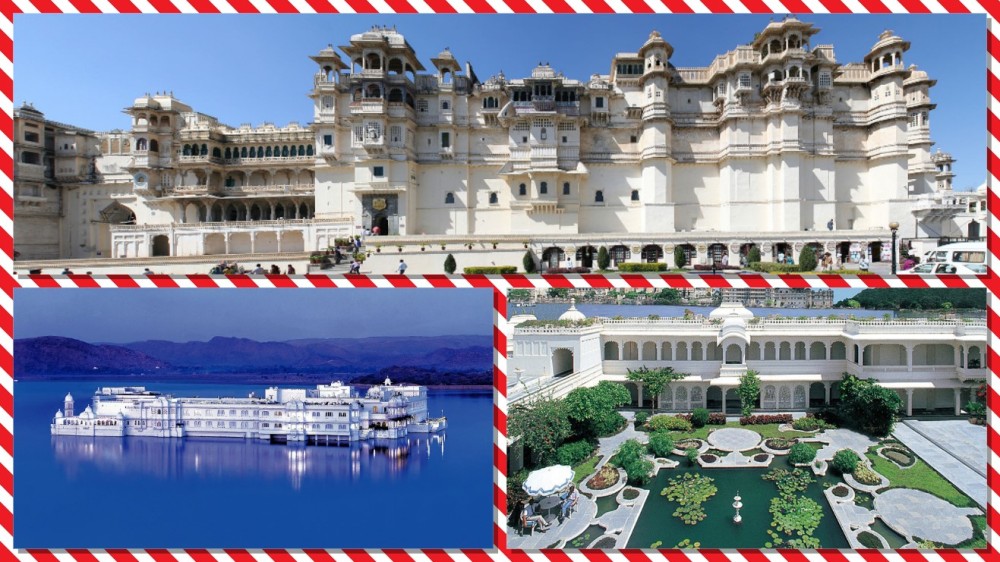
The only palace which has upgraded Indians to the level of foreigners. There is no distinction between foreigners and indians for entry ticket. Currently entry ticket to the palace is being charged at Rs 280 per pax plus camera ticket @ Rs 250 probably to avoid distinction between videography and still photography. Even mobile phones are being objected by security and attracts ticket. The entry ticket for other monuments are Jag Mandir Palace at Rs 750 in the middle of Pichola Lake. Lake palace is run as a 5 star hotel, buffet can cost upwards 2500 per pax. Similarly there are entry tickets for Crystal palace, Heritage car palace which is situated away from City Palace. The cost of one day visit can be exhorbitant for a family, for some budgetted visitors it may be an avoid with a fleeting visit outside the palace premises. A panaromic view of the complex can be had from the rope while visiting Karni Mata temple.

The construction of this palace began in 1559 by Maharana Udai Singh II and portions were added on by subsequent generations (76 of Sisodias ) over 4 centuries. The palace is constructed with granite, marble and wooden doorways. A number of balconies and terraces are constructed overlooking the lake. The palace consists of four storyed structure built homogenous with moghul and indian architecture. There are two palaces ( Fatehprakash and Shiv Niwas ) which are now converted into heritage hotels. The entire complex belongs to the Mewar royal family and is maintained by the trusts with help of ASI.
One can spend nearly two to three hours visiting the museum with a wide range of collections ranging from costumes, cutlery, weaponary, paintings, mirror works and small landscaped garden along with the lake front leading to Jag Mandir isle and Lake Palace.
Lake Palace ( Jag Niwas ) Situated in midst of Lake Pichola is currently a heritage hotel run by Taj group of hotels from 1971. It has 66 luxurious rooms along with 17 grand suites.
Maharana Jagat Singh II was literally caught with his pants down frolicking with ladies from the zenana, he thought it wise to build a palace for pleasure in midst of Pichola lake. This was built in 1746 and it was known as Jag Niwas. This was twice renovated in 1971 & 2000 by Taj and is currently known as Lake Palace. A buffet dinner can set off with price ranging from 3500 per pax to 7000 per pax.
This hotel is termed as the most romantic hotel in the world considering its legacy, it also forms a venue for fairy tale weddings and also symbolises Venice of the East. This hotel formed a location of the legendary Bond movie Octopussy in 1983 with Roger More ( playing as 007 ) Maud Adams ( As Octopussy ) Kabir Bedi, Vijay Amritraj and many others. Most of the film was shot in and around the City and Lake Palace. Roger Moore is alleged to have stomach upsets probably splurging on fishes.

Jagdish Mandir : This Hindu temple can be visited by walking across the city palace gate, one can use the tickets for exit from the palace and for once again entering and exiting the palace from the main gate. This double storeyed temple was constructed in 1651 with Lord Jaganath as deity. The temple opens at 5 pm in the evening, obviously closed during lunch time. Two huge elephants greet as one climbs the staircase to the enterance of the temple. There are plenty of sovenier shopping places in and around the temple. The main shopping can be done at Hatipole market.
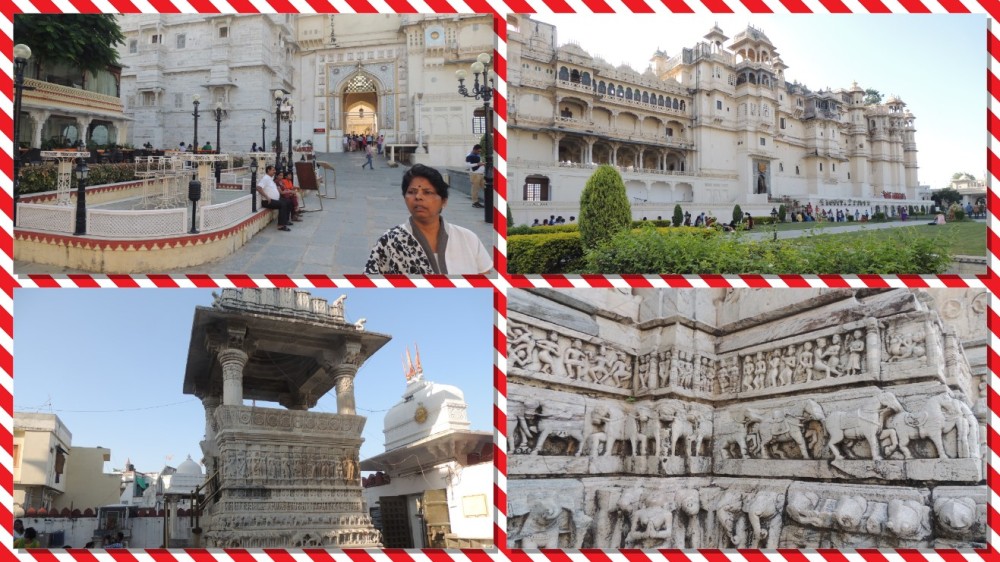
Jag Mandir Palace : It is situated in midst of lake Pichola wherein the ferry and speed boats are used to ferry the tourist for sight seeing. It is open to public and one has to pay a steep price of around Rs 750 /- per pax. Its construction was completed in 1652 and was named after Maharana Jagat Singh. The royal family used it for holding parties and get together in honour of its visitors. On two historic occasions this palace played a pivotal role in acting as refugee place.
Prince Khurram ( Shahjahan ) rebelled against his father Jahangir and was given refuge by Maharana Karan Singh. His two sons Prince Dara & Prince Aurangazeb along with Mumtaz Mahal too were given protection. Intially they were lodged in the main city palace but later shifted to Gul Mahal which was also known as Khurram Palace for sometime. Jag Mandir had a zenana too, a royal chamber for the ladies. There is a garden along with the fountain wherein open air parties were thrown.
During the Sepoy Mutiny in 1857, Maharana Swroop Singh gave shelter to many Europeans in Jag Mandir palace thus saving them from slaughter. The palace was built with twelve huge marble slabs and therefore came to be known as Bara Patharon ki Mahal.
Fateh Sagar Lake : This lake was constructed by Maharaja Fateh Singh in 1680 using three causways to supply water to the lake. There are three small islands on this lake and biggest one is Nehru park. There is a small dam to control the flow of water so that the lake is not breached. During excessive monsoon floodgates are opened to discharge excess water. To prevent evaporation cetyl alcohol is sprayed over the lake. This lake takes care of the drinking water needs of the city. There is a solar observatory in one of the Isle on the lake. Motor boats are used to ferry the tourist across the lake and towards Nehru Park.
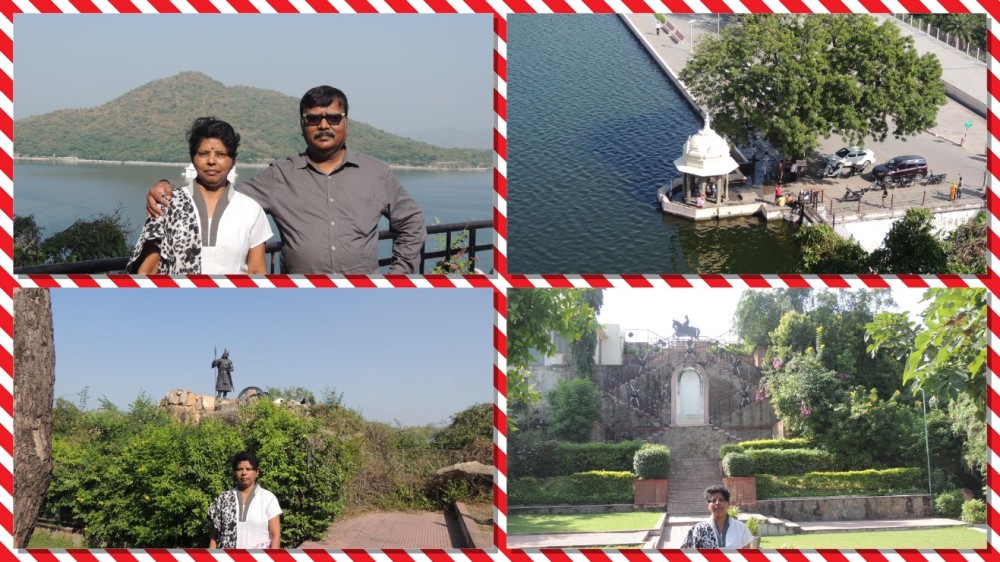
Moti Magri : A hillock on which statue of Maharana Prataph Singh’s astride his favourite horse Chetak is built as a memorial. This place is nicely landscaped and has the remanants of old fortress and a temple. One can visit the Museum too to have a glimpse of the model of the Chittaurgarh and Kumbalgarh fortress. There numerous paintings of the kings from the Mewar region in the museum. This place is ticketed monument which is reasonably priced and maintained by a trust.
Saheliyon Ki Bari : This garden is built on the banks of Fateh Sagar Lake by Maharana Sangram Singh for the royal ladies in 1734. The garden is well maintained and some collections of the royal family are displayed. It has small enclosure with a fountain. Opp. to the garden gate is the Heritage car museum and a restaurant which serves Rajasthan Thali.

Maniklal Verma Park : This hillock leads to Karni mata temple. This park was developed by the Zilla Parishad in 1995. This has free entry and a pathway leading to the temple on the hillock is visible for tourist to undertake a trek. A ropeway can be used to descent from the hillock. A panoramic view of the city palace and lake Pichola can be had from this place.
Tribal Museum : Bharatiya Lok Kala Mandal Close to Sukhadia circle we have the tribal museum and puppet show centre which is an educational one. The tribal museum has an entry fees. It displays the ancient culture of the states of Gujarat, Rajasthan and MP. Various models, paintings, costumes, puppets, tribal pictures, history, ornaments, etc are on display in the exhibition.
Sukhadia Circle : In the midst of the city huge circle with a 21 feet fountain is located which is lit up in the night. Food stalls and Kids play zone is prevalent. It is situated in the northern part of Udaipur city enroute to Ranakpur. The circle is named after the ex CM Mohanlal Sukhadia and it was thrown open to public in 1970.
One can hire an auto rickshaw for a full day after bargaining they charge anywhere between 500 – 700 bucks depending on the number of points and hours spent. We hired one such auto and kept moving around from point to point and ultimately he dropped us to our dinner restaurant at Natraj which serves the best Rajasthani thali. This restaurant is located very close to the railway station and besides that one more hotel Goverdhan also serves thali. The restaurant opens at 7pm till 10.30 pm. Most of the time one has to wait in the queue, we landed 5 minutes before it opened and we were lucky get the seat immediately. Within a few minutes the Queue system was prevalent. The hotel serves hot chappatis, along with innumerable vegetable side dishes and sweet dessert in the end. It was full value for money provided one has a good appetite. Even though we are not good eaters in the night we wanted to get a taste of the same and were thoroughly convinced regarding the hygienic food served.
Other tourist spots : Depending on the time and number of days available one can choose to visit the following spots in Udaipur. 1. Ahar Centophs 2. Bagore Ki Haveli 3. Deen Dayal Upadhya Park 4. Gulab Bagh Zoo 5. Haldighat Pass 6. Monsoon Palace ( Sajjangarh Fort ) 7. Neemuch Mata Temple 8. Sajjangarh Biological Park 9. Shilpgram 10. Karni mata Mandir through ropeway. We chose to visit Jaisamand lake and Hawa Mahal which is 52 km away.
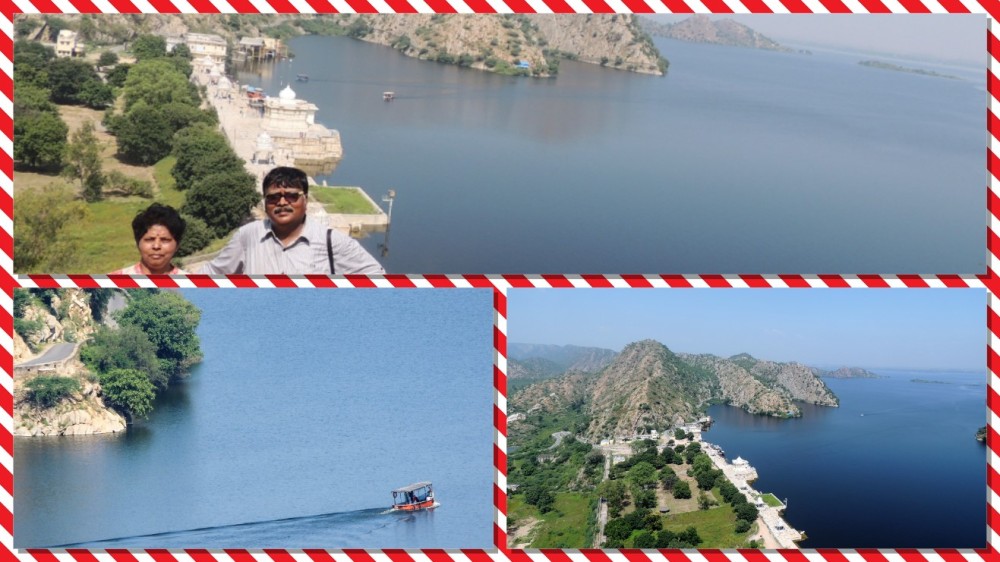
Jaisamand Lake : My wife went through the tourist guide and recommended to visit this spot. It is also known as Dhebar lake. It is known as the Asia’s largest artificial lake earlier Bhopal’s Upper lake had the distinction of being the one, now the water capacity has been considerably reduced. It covers an area of 34 square kilometers and is protected by Wildlife sanctuary. It was built by Rana Jai Singh in the 17th century. He built a marble dam across the river Gomati.
While travelling in the bus we got an interesting piece of information that fresh water fish fry is available in stalls. We made up our mind to definitely try the same during the lunch time. On our return we tried some of the river fish which is oil fried with least masala. It was fresh and tasty. Unfortunately we did not have any other item for lunch except phulka chapati or dal bhatti. We tried a litte bit of dal bhatti which is almost half cooked flooded with ghee.
Jaisamand lake was world’s largest lake when it was built in 1685 till a lake was developed over Aswan dam in Egypt in 1902. There are three isle on the this lake. Ferry boats take the tourist for a sail depending on budget or ticket. There is one more spot across the lake wherein fish stalls are located.
Hawa Mahal : It is summer palace on a hillock, we were a little apprehensive whether we can climb the same. There was a ASI student who confirmed that there is virtually no staircases and one can easily trudge on the inclined pathway laid for the tourist. This is a ticketed monument one needs to obtain the same in the forest department office located at the enterance.
The view point from Hawa Mahal is worth the trouble one takes to trek up the hillock. One is greeted by plenty of cool breeze on top of the Mahal. One can take beautiful pictures and the hillocks are really scenic. One can see the Rani Mahal on the other side of the hillock. I believe the monument has been closed because of the treasure hunters vandalizing the place. Bhil tribes are supposed to living in these hillocks.
There is a Shiva temple in the midst of six cenotaphs on the boundary of the lake. Elephants statues are located at numerous vantage points.

Chittaurgarh Fortress : After booking our tickets directly to Udaipur we found that Chittaurgarh Fortress is enroute so we deviated the plan and had a break journey to visit the fortress. This was a wise move we saved a considerable time and money in the process and covered this historical place. It is convenient to hire an auto directly from the railway station unto the fortress. Otherwise one needs to go to transit point known as OC stand from wherein one can have a share rickshaw or budget travel to cover the entire fortress. We had a window of roughly 5 hours before we had a connecting train to Udaipur. We finished our lunch and boarded an auto which was a share one to OC stand, in the meanwhile we found that the driver was interested to take us around the fortress and return to the station. We bargained and fixed a price for the same. It was really convenient since we could leave behind our shoes and belongings safely in the rickshaw. Our luggage however we decided to keep it in the cloak room at the railway station itself.
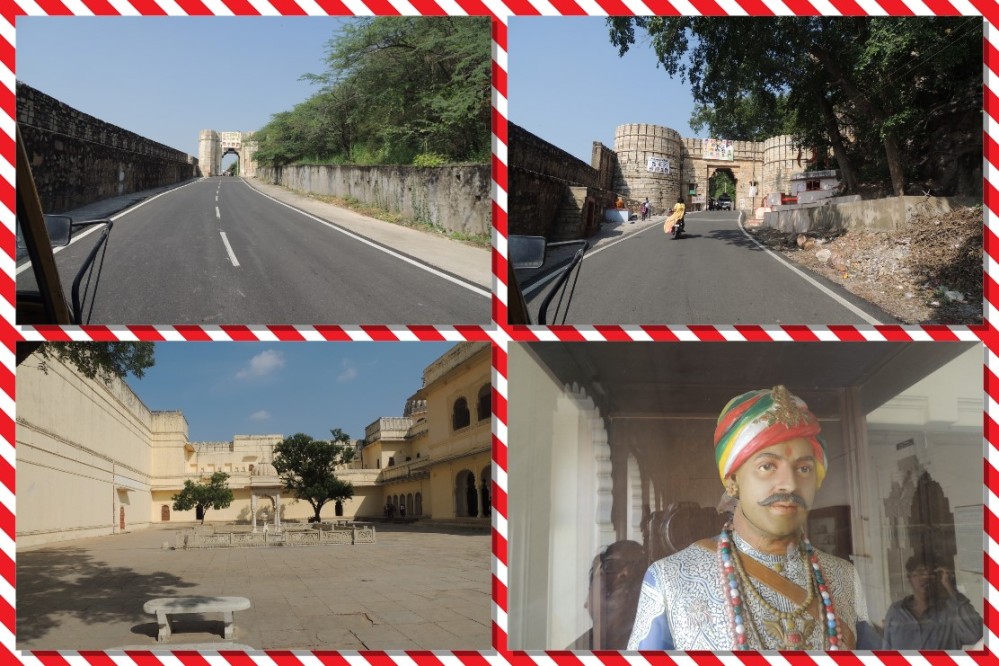
Enroute we allowed the driver to pick up and drop some passengers. He made some extra bucks and in turn he acted as a guide to our entire trip. There were number of arched gateways for the fortress which has a circumference in the shape of fish for 13 kms. In all there are 7 main gateways leading to the fort. They are namely the Padan Pol, Bhairon Pol, Hanuman Pol, Ganesh Pol, Jodla Pol, Laxman Pol and the main gate is known as Ram Pol.
The fort is supposed to have been built in the 7th century AD by the local Mauryas who might have been feudatory to Emperor Asoka, many Buddhist stupas are found in the precincts of the fortress lake. Some legendary tales attribute the fortress construction to Bheem of Mahabharat. He is said to have struck the ground to ensure that water sprouted and it is known as Bheem Kund.

Allauddin Khilji laid seize of the fortress in 1303 inorder to capture the queen Rani Padmini. He was fascinated by her hearsay beauty equating to the legendary Cleopatra. He wanted to secure her for his harem. King Ratan Singh was deceitfully captured by Allauddin Khilji and a ransom was sought to seek possession of Padmini in return. However the queen laid down a condition that he can see through the mirror, which increased his lust to possess her. He was not willing to release her husband. Instead she once laid a condition that she will be accompanied by her consorts to visit him. She never turned up instead there were guerilla soldiers sent to release the captured King. There was a ferocious battle which ensued the escape. Queen Padmini and the entire clan of ladies jumped into the funeral pyre. Thus the ancient tradition of Jauhar was committed to maintain the honour and dignity of the royal ladies. Ratan Singh lost the battle to his enemies amidst huge bloodshed and massacre. The fort was handed over to Allauddin Khilji’s son Khizir and it was renamed Khizarbad.

Chittaurgarh witnessed number of intrigues and conspiracies over the years. It was usurped by Hammir Singh and later his grandson Rana Kumbha who reigned the kingdom between 1433 to 1468. During his period he fortified the entire kingdom with 32 forts including Kumbalgarh named after him. He was assassinated by Rana Uday Singh I who was his own son. Sangram Singh took over the reigns and he fought a valiant battle against Babur 1527. Later Bahadur Shah laid seize over the fort in 1535. Once again women committed Jauhar at the fortress.
In 1567 Akbar invaded the fortress and laid seize for almost 6 months before capturing the fortress among the ruins of Jauhar once again committed by royalty.
Some of the important landmarks at the fortress are as follows :
Vijay Stambh : It is also known as tower of Victory. It was erected by Rana Kumbha during 1458 to 1468. The tower raises to above 37 meters high, with 8 storeys and 157 circular steps leading upto the balcony. The dome is illuminated nowadays during night times.
Kirti Stambh : It is built by a jain merchant in dedication of Lord Adinath. He is the first Jain Thirtankar and teacher. This tower raises above 22 meters in height. A narrow staircase leads to 6 storey balcony.
Rana Kumbha Palace : At the entrance to Vijay Stambh is the palace which is now in ruins. The palace seems to have been witness to many historical events such Panna Dhai substituting her son to save Mahrana Udai Singh, Rani Padmini committing Jauhar in underground cellar, and many other events changing the course of history.
Fateh Prakash Palace : This palace is now converted into a museum.
Gaumukh Reservoir : A perennial spring fills the tank inside the fortress. This premise has a small temple too.
Padmini Palace : A three storied structure is surrounded by water, wherein resided Queen Padmini. Allauddin Khilji is supposed to have had a glimpse of the queen at this premises. He was obviously enamoured by the beauty of the queen that he literally destroyed the entire fortress in frustration when the queen committed Jauhar.
Jain Temple : One of the well preserved ancient structure is dedicated to one of the thirtankaras of Jain religion.
Kali Mata temple : This temple is located close to Padmini Palace. It is a place wherein sacrifices of animals take place to please the goddess.
One can literally spend the entire day discovering various monuments of the fortress. The place can be extremely hot, it is better to equip oneself with a good polaroid glares, sunscreen and Umbrella. Winter season would be best time to explore the fortress.
Round taxi trip around Udaipur : The taxi operators insist that we cover 300 kms in a day inorder to be charged on km basis. We wanted to cover Shrinathji temple at Nathdwar, Haldighat, Kumbalgarh and Ranakpur temple. If one needs to cover all these places comfortably one needs to begin as early as 6.30 am. We did start at around this time but there was a vehicle breakdown. Luckily after 45 minutes we got a replacement vehicle by the taxi operator.
Unfortunately the driver of the other vehicle was a tricky character he started deliberately slowing down the speed of the vehicle and taking us shopping points which we refused to even oblige. We had to taunt him and ensure that we cover all the places that we had planned in our itineary. The driver was little pyscho by the way since he was compelled to become a priest since he did not find any girl for marriage we presume. He became a forced bachelor.
Shrinathji Temple : The idol of Lord Krishna was moved from Govardhan to Nathdwara during the 17th century during the upheavel. The temple was built by Raj Singh under the guidance of priests in 1672.
The image of Lord Krishna is supposed to symbolise the lifting of Goverdhan Hill to protect his disciples from flooding. The black idol with diamond embedded below the lips . The entire slab is with a relief consisting of cows, lion, snake, peacock and sages besides.
Folk stories of lord Krishna is placed in different rooms of the haveli. Therefore the temple is known as Nand Bhavan. The main attraction of the temple is that of aartis and shringar which is undertaken 7 times a day.
We hired a priest on the Vijaydhasmi day to ensure that we have a quick dharsan. He took Rs 50 and plus some tips for ensuring that we have a quick dharsan. It was really amazing how he was able to ensure that we have a safe trip turn by turn. My wife had some difficulty in finding her way back since the temple was closed for a short time. The priest was huffing and puffing since he was not able to find her. I was relaxed and after a few minutes she returned safely. Once again the driver of the car went into hiding and it took more than 30 minutes to locate him. His phone had signal problem too.
Haldighat : On our journey some passengers told us that Haldighat is located close to Nathdwara so it became a part of our itineary. The historical battle between Akbar and Maharana Pratap Singh was fought on June 21st 1576, in which the valiant horse Chetak was fatally wounded and died.
There are four are five points in Haldighat one is the Rakt Talai or blood soaked pond. This place is maintained by ASI and does not invite any fees, a beautiful landscaped garden and Centoph is created marking the battle place. Maharana’s general Hakim was felled here and a small graveyard is built in the premises.
Another point is Chetak Smarak which is besides a temple and probably a tributary of the river too was running across.
There is another place wherein probably a fortress and palace was located and now it is converted into rural tourism centre complex filled with statues, theatre and shopping points. Even one can have a vegetarian lunch at this premises. A small cartoon film on the battle of Haldighat is shown along with tour inside the cave displaying various facets of Maharana’s life.
Our driver once again played a trick by not taking us to spot wherein a memorial of Chetak is recently installed. This hillock has a fortress type of stucture which is in ruins. The drivers excuse there were sharp stones which can puncture his tyre.
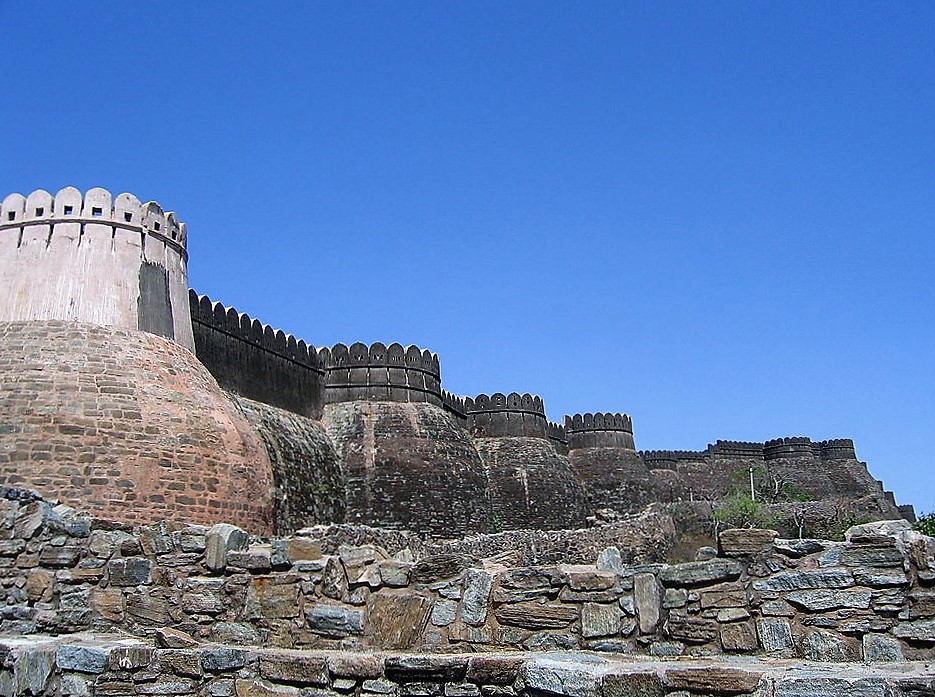
Kumbalgarh : Kubalgarh fortress walled structure is spread across 38 kms and it is bestowed world heritage site status in 2007. It is the second longest walled structure after the great wall of China.
The original fortress seems to have been built by King Samprati of Maura in the 6th century. But the fortress in current form is credited to be built by Rana Kumbha. The peculiar vessel like fortress wall is unique amongst all the fortress. Probably the architect conceived it to have a better foundation for the gateways and give a unique look. The famous architect of time Madam is supposed to have designed this fortress along with 32 others.
Historical events such as rescue of Prince Udai Singh, the founder of Udaipur city by Panna Dhai Ma from Chittaurgarh. Birth of Maharana Prataph Singh in this fortress and Capture of the fort by Akbar in 1576 which was only time when the defences were breached. The thickness of wall is 15 feet and 7 fortified gateways are built at vantage point for entry into the fortress.
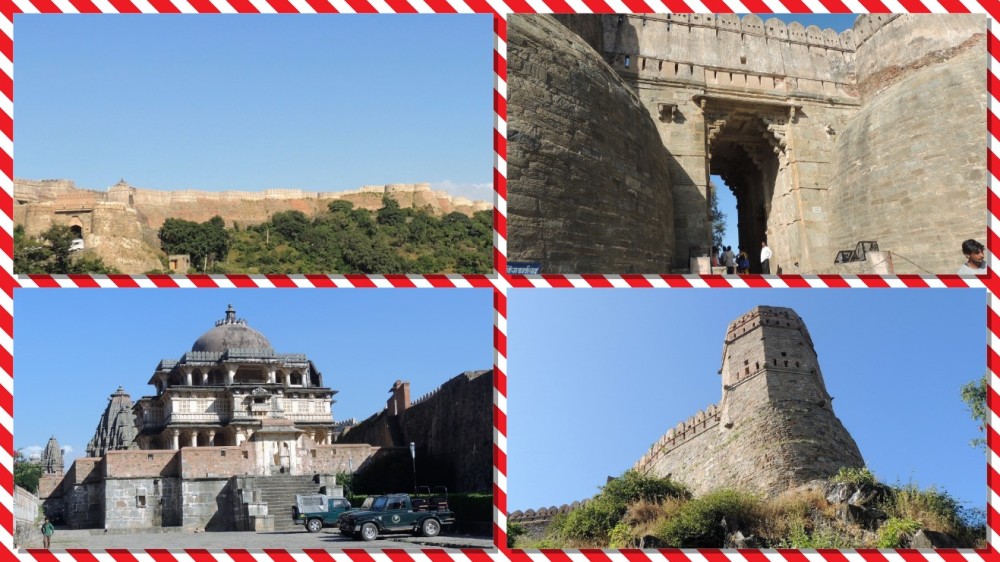
Some of the important landmarks inside the fortress are Lakhola tank which is spread across 5 kms. It was used for drinking purpose by the soldiers guarding the fortress and royalty. There is a hindu Ganesh and Shiv Temple which were built in 1458. The idol of Shiva is made of black granite and depicted by 12 hands. The temple was renovated by Rana Sangha.
A Jain temple dedicated to one of the Jain Thirtankara Parsvanath was built in 1513. There is a Mataji temple located on the southern side. Surya or Sun temple is also present inside the fortress.
Legendary tales of the construction of the fortress points to an obstacle to build a wall near the enterance of the fort. A divine intervention was sought regarding overcoming the difficulty faced in construction. The King was advised by the tantric that a voluntary human sacrifice has to be undertaken so that the evil spirits are driven away. For sometime there was no volunteer for the sacrifice but one day a piligrim came and was ready for the sacrifice as per the rituals. He was beheaded near the enterance and thus the obstacle faced in construction was removed. In his memory a temple was constructed near the enterance.

Sound and light show is also organised by ASI thankfully with minimum ticket price. Tourism department organises concerts and dance festival along with Heritage Fort walk during the annual festivity in memory of Maharana Kumbha. A wildlife sanctuary is located around the Kumbalgarh fortress. There is proposal to introduce Lion and Cheetah into the sanctuary to promote tourism. The sanctuary is spread currently to over 578 kms.
We quickly ascended the fortress and completed the visit within an hour since we had to proceed to the next destination which was Ranakpur. Enroute we had doubts whether we would be able to see the temple since we heard that temple is closed at 5 pm which was not practical. When we saw a state transport bus speeding across we knew we had some remote chance. The hilly track made it impossible to speed. However we managed to reach the temple premises at 5.30 pm. The security guard told us to remove all leather items and deposit the camera in the security. Photography is allowed only between 12 to 5 pm.
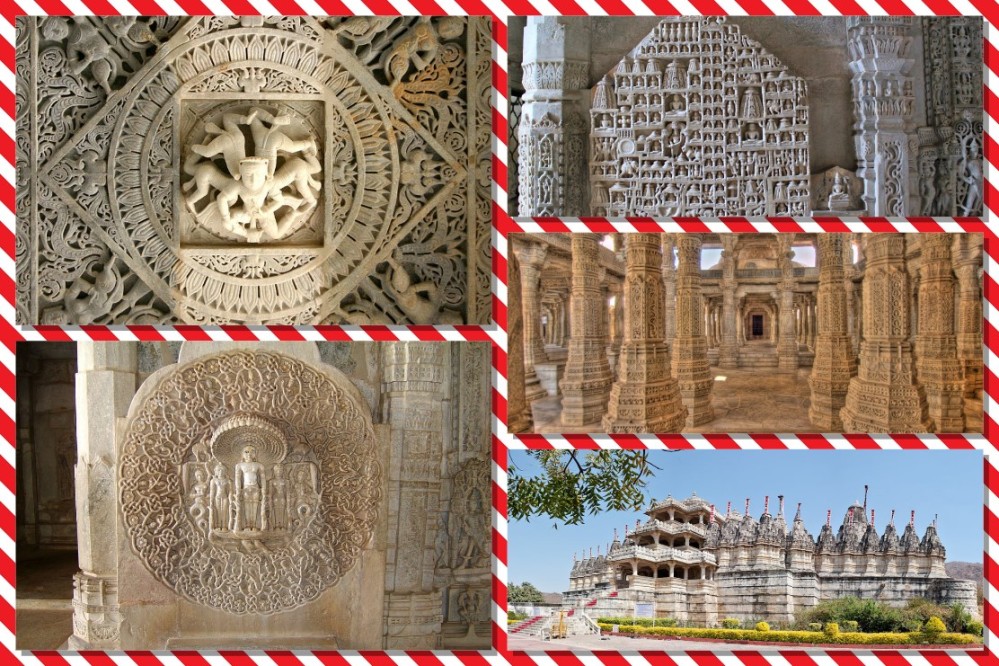
Ranakpur Temple : Our final destination on the taxi trip was Ranakpur temple. This temple is dedicated to Adinath. This magnificent temple is constructed with marble with sanctum dedicated for various theertankaras of Jain.
The fine detailing of the marble work on pillars inside the temple is so soothing to the eyes. There are 1444 pillars supporting the domes of the temple. They are designed in such a manner that vision to the sanctum is not affected in any manner.
Legend has it that Dharenshah who in his envisoned a grand temple in the shape of a vimana or space ship. He invited many architects of the time to submit their plan to construct a temple. But he was not convinced of the grandeur dished out by many famous architects. One day a happy go lucky youth presented a plan which simply struck a chord in heart of the sponsorer. Dharenshah approached the King Rana Kumbha to provide him a land to build a temple which the King obliged gleefully. He advised him to have settlement for human living in the nearby village.
The construction of the temple began in 1446 and it took nearly 50 years for its near completion. After spending nearly 90 lakhs Dharenshah was satisfied with the grandeur of his conception. He installed huge statue of Adinath in four different directions. Thus there are four different enterances conceived originally for the temple.
A massive renovation project was undertaken in 1990 to clean up the fading marbe and it was completed in 2001. Thus the masterpiece of edifice amongst the Aravalli hills attracts piligrims and tourist from all over the world.
The nearest railway station is Falna and by air it can be reached from Udaipur.
Ack : Info and Clips from Wiki, Taj website and other research guides.
Udaipur : This city was established by Maharana Udai Singh II in 1553. Chittaurgarh was under constant seize from the moghuls and invaders. Udai Singh II decided to protect Udaipur by having 7 gates and a walled city spreading upto 6 kms. The gates were known as Hatipole, Chandpole, Surajpole, Udaipole, Ambapole, Brahmpole etc. Udaipur is located approx 2000 feet above sea level.
Udaipur is also known as city of lakes which are located on the slopes of Aravalli hills. Some of the prominent lakes are Pichola, Fateh Sagar, Swaroop Sagar, Rang Sagar, Kumaria Talab and Goverdhan Sagar.
City Palace Udaipur :
The only palace which has upgraded Indians to the level of foreigners. There is no distinction between foreigners and indians for entry ticket. Currently entry ticket to the palace is being charged at Rs 280 per pax plus camera ticket @ Rs 250 probably to avoid distinction between videography and still photography. Even mobile phones are being objected by security and attracts ticket. The entry ticket for other monuments are Jag Mandir Palace at Rs 750 in the middle of Pichola Lake. Lake palace is run as a 5 star hotel, buffet can cost upwards 2500 per pax. Similarly there are entry tickets for Crystal palace, Heritage car palace which is situated away from City Palace. The cost of one day visit can be exhorbitant for a family, for some budgetted visitors it may be an avoid with a fleeting visit outside the palace premises. A panaromic view of the complex can be had from the rope while visiting Karni Mata temple.
The construction of this palace began in 1559 by Maharana Udai Singh II and portions were added on by subsequent generations (76 of Sisodias ) over 4 centuries. The palace is constructed with granite, marble and wooden doorways. A number of balconies and terraces are constructed overlooking the lake. The palace consists of four storyed structure built homogenous with moghul and indian architecture. There are two palaces ( Fatehprakash and Shiv Niwas ) which are now converted into heritage hotels. The entire complex belongs to the Mewar royal family and is maintained by the trusts with help of ASI.
One can spend nearly two to three hours visiting the museum with a wide range of collections ranging from costumes, cutlery, weaponary, paintings, mirror works and small landscaped garden along with the lake front leading to Jag Mandir isle and Lake Palace.
Lake Palace ( Jag Niwas ) Situated in midst of Lake Pichola is currently a heritage hotel run by Taj group of hotels from 1971. It has 66 luxurious rooms along with 17 grand suites.
Maharana Jagat Singh II was literally caught with his pants down frolicking with ladies from the zenana, he thought it wise to build a palace for pleasure in midst of Pichola lake. This was built in 1746 and it was known as Jag Niwas. This was twice renovated in 1971 & 2000 by Taj and is currently known as Lake Palace. A buffet dinner can set off with price ranging from 3500 per pax to 7000 per pax.
This hotel is termed as the most romantic hotel in the world considering its legacy, it also forms a venue for fairy tale weddings and also symbolises Venice of the East. This hotel formed a location of the legendary Bond movie Octopussy in 1983 with Roger More ( playing as 007 ) Maud Adams ( As Octopussy ) Kabir Bedi, Vijay Amritraj and many others. Most of the film was shot in and around the City and Lake Palace. Roger Moore is alleged to have stomach upsets probably splurging on fishes.
Jagdish Mandir : This Hindu temple can be visited by walking across the city palace gate, one can use the tickets for exit from the palace and for once again entering and exiting the palace from the main gate. This double storeyed temple was constructed in 1651 with Lord Jaganath as deity. The temple opens at 5 pm in the evening, obviously closed during lunch time. Two huge elephants greet as one climbs the staircase to the enterance of the temple. There are plenty of sovenier shopping places in and around the temple. The main shopping can be done at Hatipole market.
Jag Mandir Palace : It is situated in midst of lake Pichola wherein the ferry and speed boats are used to ferry the tourist for sight seeing. It is open to public and one has to pay a steep price of around Rs 750 /- per pax. Its construction was completed in 1652 and was named after Maharana Jagat Singh. The royal family used it for holding parties and get together in honour of its visitors. On two historic occasions this palace played a pivotal role in acting as refugee place.
Prince Khurram ( Shahjahan ) rebelled against his father Jahangir and was given refuge by Maharana Karan Singh. His two sons Prince Dara & Prince Aurangazeb along with Mumtaz Mahal too were given protection. Intially they were lodged in the main city palace but later shifted to Gul Mahal which was also known as Khurram Palace for sometime. Jag Mandir had a zenana too, a royal chamber for the ladies. There is a garden along with the fountain wherein open air parties were thrown.
During the Sepoy Mutiny in 1857, Maharana Swroop Singh gave shelter to many Europeans in Jag Mandir palace thus saving them from slaughter. The palace was built with twelve huge marble slabs and therefore came to be known as Bara Patharon ki Mahal.
Fateh Sagar Lake : This lake was constructed by Maharaja Fateh Singh in 1680 using three causways to supply water to the lake. There are three small islands on this lake and biggest one is Nehru park. There is a small dam to control the flow of water so that the lake is not breached. During excessive monsoon floodgates are opened to discharge excess water. To prevent evaporation cetyl alcohol is sprayed over the lake. This lake takes care of the drinking water needs of the city. There is a solar observatory in one of the Isle on the lake. Motor boats are used to ferry the tourist across the lake and towards Nehru Park.
Moti Magri : A hillock on which statue of Maharana Prataph Singh’s astride his favourite horse Chetak is built as a memorial. This place is nicely landscaped and has the remanants of old fortress and a temple. One can visit the Museum too to have a glimpse of the model of the Chittaurgarh and Kumbalgarh fortress. There numerous paintings of the kings from the Mewar region in the museum. This place is ticketed monument which is reasonably priced and maintained by a trust.
Saheliyon Ki Bari : This garden is built on the banks of Fateh Sagar Lake by Maharana Sangram Singh for the royal ladies in 1734. The garden is well maintained and some collections of the royal family are displayed. It has small enclosure with a fountain. Opp. to the garden gate is the Heritage car museum and a restaurant which serves Rajasthan Thali.
Maniklal Verma Park : This hillock leads to Karni mata temple. This park was developed by the Zilla Parishad in 1995. This has free entry and a pathway leading to the temple on the hillock is visible for tourist to undertake a trek. A ropeway can be used to descent from the hillock. A panoramic view of the city palace and lake Pichola can be had from this place.
Tribal Museum : Bharatiya Lok Kala Mandal Close to Sukhadia circle we have the tribal museum and puppet show centre which is an educational one. The tribal museum has an entry fees. It displays the ancient culture of the states of Gujarat, Rajasthan and MP. Various models, paintings, costumes, puppets, tribal pictures, history, ornaments, etc are on display in the exhibition.
Sukhadia Circle : In the midst of the city huge circle with a 21 feet fountain is located which is lit up in the night. Food stalls and Kids play zone is prevalent. It is situated in the northern part of Udaipur city enroute to Ranakpur. The circle is named after the ex CM Mohanlal Sukhadia and it was thrown open to public in 1970.
One can hire an auto rickshaw for a full day after bargaining they charge anywhere between 500 – 700 bucks depending on the number of points and hours spent. We hired one such auto and kept moving around from point to point and ultimately he dropped us to our dinner restaurant at Natraj which serves the best Rajasthani thali. This restaurant is located very close to the railway station and besides that one more hotel Goverdhan also serves thali. The restaurant opens at 7pm till 10.30 pm. Most of the time one has to wait in the queue, we landed 5 minutes before it opened and we were lucky get the seat immediately. Within a few minutes the Queue system was prevalent. The hotel serves hot chappatis, along with innumerable vegetable side dishes and sweet dessert in the end. It was full value for money provided one has a good appetite. Even though we are not good eaters in the night we wanted to get a taste of the same and were thoroughly convinced regarding the hygienic food served.
Other tourist spots : Depending on the time and number of days available one can choose to visit the following spots in Udaipur. 1. Ahar Centophs 2. Bagore Ki Haveli 3. Deen Dayal Upadhya Park 4. Gulab Bagh Zoo 5. Haldighat Pass 6. Monsoon Palace ( Sajjangarh Fort ) 7. Neemuch Mata Temple 8. Sajjangarh Biological Park 9. Shilpgram 10. Karni mata Mandir through ropeway. We chose to visit Jaisamand lake and Hawa Mahal which is 52 km away.
Jaisamand Lake : My wife went through the tourist guide and recommended to visit this spot. It is also known as Dhebar lake. It is known as the Asia’s largest artificial lake earlier Bhopal’s Upper lake had the distinction of being the one, now the water capacity has been considerably reduced. It covers an area of 34 square kilometers and is protected by Wildlife sanctuary. It was built by Rana Jai Singh in the 17th century. He built a marble dam across the river Gomati.
While travelling in the bus we got an interesting piece of information that fresh water fish fry is available in stalls. We made up our mind to definitely try the same during the lunch time. On our return we tried some of the river fish which is oil fried with least masala. It was fresh and tasty. Unfortunately we did not have any other item for lunch except phulka chapati or dal bhatti. We tried a litte bit of dal bhatti which is almost half cooked flooded with ghee.
Jaisamand lake was world’s largest lake when it was built in 1685 till a lake was developed over Aswan dam in Egypt in 1902. There are three isle on the this lake. Ferry boats take the tourist for a sail depending on budget or ticket. There is one more spot across the lake wherein fish stalls are located.
Hawa Mahal : It is summer palace on a hillock, we were a little apprehensive whether we can climb the same. There was a ASI student who confirmed that there is virtually no staircases and one can easily trudge on the inclined pathway laid for the tourist. This is a ticketed monument one needs to obtain the same in the forest department office located at the enterance.
The view point from Hawa Mahal is worth the trouble one takes to trek up the hillock. One is greeted by plenty of cool breeze on top of the Mahal. One can take beautiful pictures and the hillocks are really scenic. One can see the Rani Mahal on the other side of the hillock. I believe the monument has been closed because of the treasure hunters vandalizing the place. Bhil tribes are supposed to living in these hillocks.
There is a Shiva temple in the midst of six cenotaphs on the boundary of the lake. Elephants statues are located at numerous vantage points.
Chittaurgarh Fortress : After booking our tickets directly to Udaipur we found that Chittaurgarh Fortress is enroute so we deviated the plan and had a break journey to visit the fortress. This was a wise move we saved a considerable time and money in the process and covered this historical place. It is convenient to hire an auto directly from the railway station unto the fortress. Otherwise one needs to go to transit point known as OC stand from wherein one can have a share rickshaw or budget travel to cover the entire fortress. We had a window of roughly 5 hours before we had a connecting train to Udaipur. We finished our lunch and boarded an auto which was a share one to OC stand, in the meanwhile we found that the driver was interested to take us around the fortress and return to the station. We bargained and fixed a price for the same. It was really convenient since we could leave behind our shoes and belongings safely in the rickshaw. Our luggage however we decided to keep it in the cloak room at the railway station itself.
Enroute we allowed the driver to pick up and drop some passengers. He made some extra bucks and in turn he acted as a guide to our entire trip. There were number of arched gateways for the fortress which has a circumference in the shape of fish for 13 kms. In all there are 7 main gateways leading to the fort. They are namely the Padan Pol, Bhairon Pol, Hanuman Pol, Ganesh Pol, Jodla Pol, Laxman Pol and the main gate is known as Ram Pol.
The fort is supposed to have been built in the 7th century AD by the local Mauryas who might have been feudatory to Emperor Asoka, many Buddhist stupas are found in the precincts of the fortress lake. Some legendary tales attribute the fortress construction to Bheem of Mahabharat. He is said to have struck the ground to ensure that water sprouted and it is known as Bheem Kund.
Allauddin Khilji laid seize of the fortress in 1303 inorder to capture the queen Rani Padmini. He was fascinated by her hearsay beauty equating to the legendary Cleopatra. He wanted to secure her for his harem. King Ratan Singh was deceitfully captured by Allauddin Khilji and a ransom was sought to seek possession of Padmini in return. However the queen laid down a condition that he can see through the mirror, which increased his lust to possess her. He was not willing to release her husband. Instead she once laid a condition that she will be accompanied by her consorts to visit him. She never turned up instead there were guerilla soldiers sent to release the captured King. There was a ferocious battle which ensued the escape. Queen Padmini and the entire clan of ladies jumped into the funeral pyre. Thus the ancient tradition of Jauhar was committed to maintain the honour and dignity of the royal ladies. Ratan Singh lost the battle to his enemies amidst huge bloodshed and massacre. The fort was handed over to Allauddin Khilji’s son Khizir and it was renamed Khizarbad.
Chittaurgarh witnessed number of intrigues and conspiracies over the years. It was usurped by Hammir Singh and later his grandson Rana Kumbha who reigned the kingdom between 1433 to 1468. During his period he fortified the entire kingdom with 32 forts including Kumbalgarh named after him. He was assassinated by Rana Uday Singh I who was his own son. Sangram Singh took over the reigns and he fought a valiant battle against Babur 1527. Later Bahadur Shah laid seize over the fort in 1535. Once again women committed Jauhar at the fortress.
In 1567 Akbar invaded the fortress and laid seize for almost 6 months before capturing the fortress among the ruins of Jauhar once again committed by royalty.
Some of the important landmarks at the fortress are as follows :
Vijay Stambh : It is also known as tower of Victory. It was erected by Rana Kumbha during 1458 to 1468. The tower raises to above 37 meters high, with 8 storeys and 157 circular steps leading upto the balcony. The dome is illuminated nowadays during night times.
Kirti Stambh : It is built by a jain merchant in dedication of Lord Adinath. He is the first Jain Thirtankar and teacher. This tower raises above 22 meters in height. A narrow staircase leads to 6 storey balcony.
Rana Kumbha Palace : At the entrance to Vijay Stambh is the palace which is now in ruins. The palace seems to have been witness to many historical events such Panna Dhai substituting her son to save Mahrana Udai Singh, Rani Padmini committing Jauhar in underground cellar, and many other events changing the course of history.
Fateh Prakash Palace : This palace is now converted into a museum.
Gaumukh Reservoir : A perennial spring fills the tank inside the fortress. This premise has a small temple too.
Padmini Palace : A three storied structure is surrounded by water, wherein resided Queen Padmini. Allauddin Khilji is supposed to have had a glimpse of the queen at this premises. He was obviously enamoured by the beauty of the queen that he literally destroyed the entire fortress in frustration when the queen committed Jauhar.
Jain Temple : One of the well preserved ancient structure is dedicated to one of the thirtankaras of Jain religion.
Kali Mata temple : This temple is located close to Padmini Palace. It is a place wherein sacrifices of animals take place to please the goddess.
One can literally spend the entire day discovering various monuments of the fortress. The place can be extremely hot, it is better to equip oneself with a good polaroid glares, sunscreen and Umbrella. Winter season would be best time to explore the fortress.
Round taxi trip around Udaipur : The taxi operators insist that we cover 300 kms in a day inorder to be charged on km basis. We wanted to cover Shrinathji temple at Nathdwar, Haldighat, Kumbalgarh and Ranakpur temple. If one needs to cover all these places comfortably one needs to begin as early as 6.30 am. We did start at around this time but there was a vehicle breakdown. Luckily after 45 minutes we got a replacement vehicle by the taxi operator.
Unfortunately the driver of the other vehicle was a tricky character he started deliberately slowing down the speed of the vehicle and taking us shopping points which we refused to even oblige. We had to taunt him and ensure that we cover all the places that we had planned in our itineary. The driver was little pyscho by the way since he was compelled to become a priest since he did not find any girl for marriage we presume. He became a forced bachelor.
Shrinathji Temple : The idol of Lord Krishna was moved from Govardhan to Nathdwara during the 17th century during the upheavel. The temple was built by Raj Singh under the guidance of priests in 1672.
The image of Lord Krishna is supposed to symbolise the lifting of Goverdhan Hill to protect his disciples from flooding. The black idol with diamond embedded below the lips . The entire slab is with a relief consisting of cows, lion, snake, peacock and sages besides.
Folk stories of lord Krishna is placed in different rooms of the haveli. Therefore the temple is known as Nand Bhavan. The main attraction of the temple is that of aartis and shringar which is undertaken 7 times a day.
We hired a priest on the Vijaydhasmi day to ensure that we have a quick dharsan. He took Rs 50 and plus some tips for ensuring that we have a quick dharsan. It was really amazing how he was able to ensure that we have a safe trip turn by turn. My wife had some difficulty in finding her way back since the temple was closed for a short time. The priest was huffing and puffing since he was not able to find her. I was relaxed and after a few minutes she returned safely. Once again the driver of the car went into hiding and it took more than 30 minutes to locate him. His phone had signal problem too.
Haldighat : On our journey some passengers told us that Haldighat is located close to Nathdwara so it became a part of our itineary. The historical battle between Akbar and Maharana Pratap Singh was fought on June 21st 1576, in which the valiant horse Chetak was fatally wounded and died.
There are four are five points in Haldighat one is the Rakt Talai or blood soaked pond. This place is maintained by ASI and does not invite any fees, a beautiful landscaped garden and Centoph is created marking the battle place. Maharana’s general Hakim was felled here and a small graveyard is built in the premises.
Another point is Chetak Smarak which is besides a temple and probably a tributary of the river too was running across.
There is another place wherein probably a fortress and palace was located and now it is converted into rural tourism centre complex filled with statues, theatre and shopping points. Even one can have a vegetarian lunch at this premises. A small cartoon film on the battle of Haldighat is shown along with tour inside the cave displaying various facets of Maharana’s life.
Our driver once again played a trick by not taking us to spot wherein a memorial of Chetak is recently installed. This hillock has a fortress type of stucture which is in ruins. The drivers excuse there were sharp stones which can puncture his tyre.
Kumbalgarh : Kubalgarh fortress walled structure is spread across 38 kms and it is bestowed world heritage site status in 2007. It is the second longest walled structure after the great wall of China.
The original fortress seems to have been built by King Samprati of Maura in the 6th century. But the fortress in current form is credited to be built by Rana Kumbha. The peculiar vessel like fortress wall is unique amongst all the fortress. Probably the architect conceived it to have a better foundation for the gateways and give a unique look. The famous architect of time Madam is supposed to have designed this fortress along with 32 others.
Historical events such as rescue of Prince Udai Singh, the founder of Udaipur city by Panna Dhai Ma from Chittaurgarh. Birth of Maharana Prataph Singh in this fortress and Capture of the fort by Akbar in 1576 which was only time when the defences were breached. The thickness of wall is 15 feet and 7 fortified gateways are built at vantage point for entry into the fortress.
Some of the important landmarks inside the fortress are Lakhola tank which is spread across 5 kms. It was used for drinking purpose by the soldiers guarding the fortress and royalty. There is a hindu Ganesh and Shiv Temple which were built in 1458. The idol of Shiva is made of black granite and depicted by 12 hands. The temple was renovated by Rana Sangha.
A Jain temple dedicated to one of the Jain Thirtankara Parsvanath was built in 1513. There is a Mataji temple located on the southern side. Surya or Sun temple is also present inside the fortress.
Legendary tales of the construction of the fortress points to an obstacle to build a wall near the enterance of the fort. A divine intervention was sought regarding overcoming the difficulty faced in construction. The King was advised by the tantric that a voluntary human sacrifice has to be undertaken so that the evil spirits are driven away. For sometime there was no volunteer for the sacrifice but one day a piligrim came and was ready for the sacrifice as per the rituals. He was beheaded near the enterance and thus the obstacle faced in construction was removed. In his memory a temple was constructed near the enterance.
Sound and light show is also organised by ASI thankfully with minimum ticket price. Tourism department organises concerts and dance festival along with Heritage Fort walk during the annual festivity in memory of Maharana Kumbha. A wildlife sanctuary is located around the Kumbalgarh fortress. There is proposal to introduce Lion and Cheetah into the sanctuary to promote tourism. The sanctuary is spread currently to over 578 kms.
We quickly ascended the fortress and completed the visit within an hour since we had to proceed to the next destination which was Ranakpur. Enroute we had doubts whether we would be able to see the temple since we heard that temple is closed at 5 pm which was not practical. When we saw a state transport bus speeding across we knew we had some remote chance. The hilly track made it impossible to speed. However we managed to reach the temple premises at 5.30 pm. The security guard told us to remove all leather items and deposit the camera in the security. Photography is allowed only between 12 to 5 pm.
Ranakpur Temple : Our final destination on the taxi trip was Ranakpur temple. This temple is dedicated to Adinath. This magnificent temple is constructed with marble with sanctum dedicated for various theertankaras of Jain.
The fine detailing of the marble work on pillars inside the temple is so soothing to the eyes. There are 1444 pillars supporting the domes of the temple. They are designed in such a manner that vision to the sanctum is not affected in any manner.
Legend has it that Dharenshah who in his envisoned a grand temple in the shape of a vimana or space ship. He invited many architects of the time to submit their plan to construct a temple. But he was not convinced of the grandeur dished out by many famous architects. One day a happy go lucky youth presented a plan which simply struck a chord in heart of the sponsorer. Dharenshah approached the King Rana Kumbha to provide him a land to build a temple which the King obliged gleefully. He advised him to have settlement for human living in the nearby village.
The construction of the temple began in 1446 and it took nearly 50 years for its near completion. After spending nearly 90 lakhs Dharenshah was satisfied with the grandeur of his conception. He installed huge statue of Adinath in four different directions. Thus there are four different enterances conceived originally for the temple.
A massive renovation project was undertaken in 1990 to clean up the fading marbe and it was completed in 2001. Thus the masterpiece of edifice amongst the Aravalli hills attracts piligrims and tourist from all over the world.
The nearest railway station is Falna and by air it can be reached from Udaipur.
Ack : Info and Clips from Wiki, Taj website and other research guides.